Program Overview
Our program combines rigorous coursework and sound training in the fundamentals of neuroscience, including the integrated study of nervous system function and disease, with opportunities for state-of-the-art research.
Please reach out to Bruce Carter if you have any questions about the Neuroscience Ph.D. Program or the application process.
-
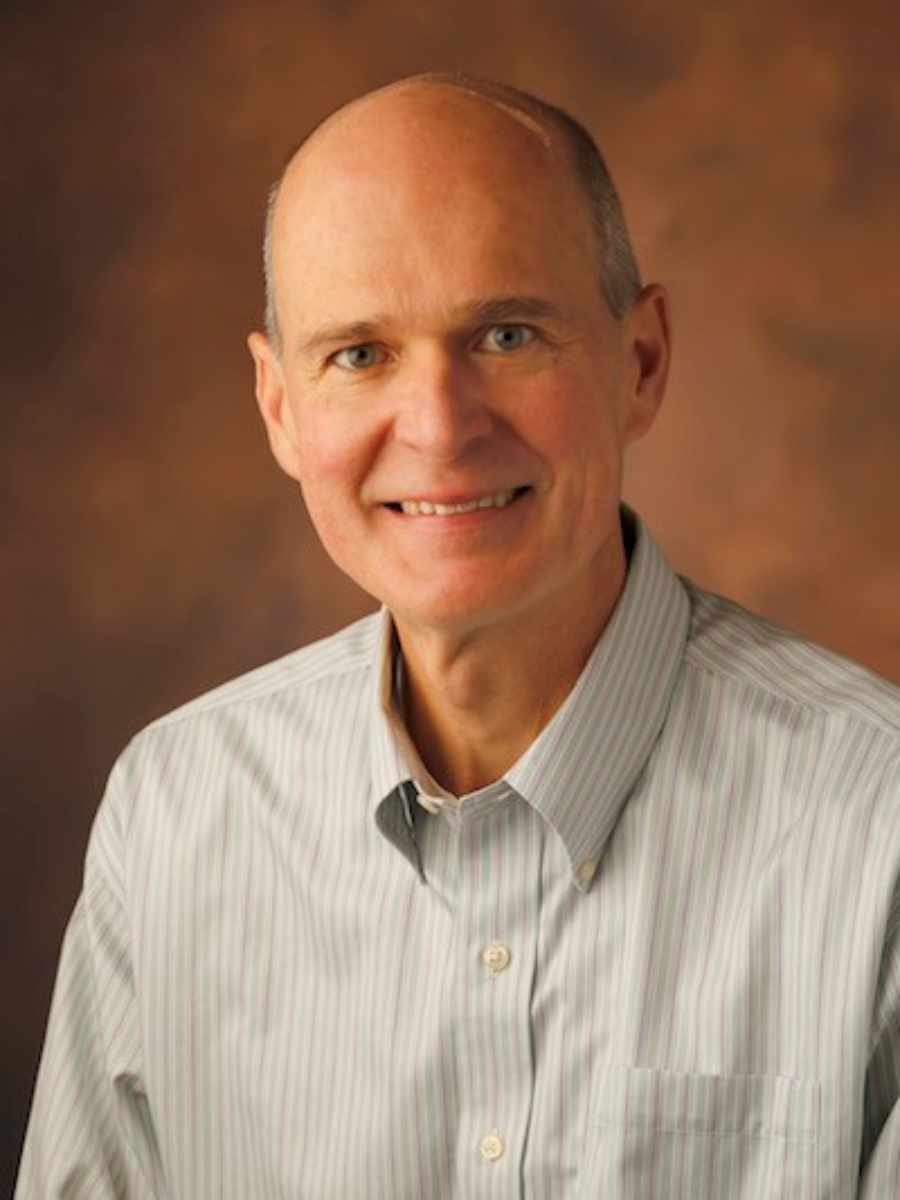
Bruce Carter
Director of Graduate Studies in Neuroscience
Associate Director for Education and Training, Vanderbilt Brain Institute
Professor of Biochemistry- 615-936-3041
- 625 Light Hall

We foster the development from trainee to independent research scientist and educator.
Individualized Attention
In any given year there are typically about 70-80 graduate students and 73 training faculty, providing an excellent student-teacher ratio that results in extensive opportunities for interaction and exchange of ideas in a relaxed and collegial atmosphere. Our distinguished training faculty stem from diverse fields such as Psychology, Biochemistry, Molecular Physiology, and Pharmacology and capture the multidisciplinary nature of modern neurobiological inquiry.
Flexible Curriculum
Our curriculum melds a rigorous and challenging core coursework designed to build a strong didactic foundation in three pillars of neuroscience – cellular and molecular neuroscience, cognitive and systems neuroscience and clinical neuroscience – with opportunities to perform cutting edge research in laboratories led by outstanding scientists with a deep commitment to the highest level of mentoring. A great strength of the program is the size and breadth of our training faculty, providing a scope of research possibilities that span the full spectrum of contemporary neuroscience. An associated bonus to this breadth is early exposure of students to a broad-based view into neuroscience through both coursework and seminars, allowing them to be conversant at all levels of neuroscience inquiry. Examples of areas covered include cognitive neuroscience, computational modeling, sensory-motor systems, neuroimaging, neural development, neurogenetics, synapse formation and plasticity, structure and regulation of ion channels, mechanisms of addiction and reward, signal transduction, psychotropic drug action, and the molecular and structural basis of neuropsychiatric and neurodegenerative disorders.
The program also includes works-in-progress seminars by all Neuroscience trainees, invited external seminar speakers including several suggested or hosted by trainees, and an annual retreat.
Career Outlook
Graduates of our department are superbly prepared for a variety of career options in both academia and industry. Each student's program is designed to provide a broad-based education in neuroscience, yet accommodate individual needs and interests to allow students to become creative, independent scientists.
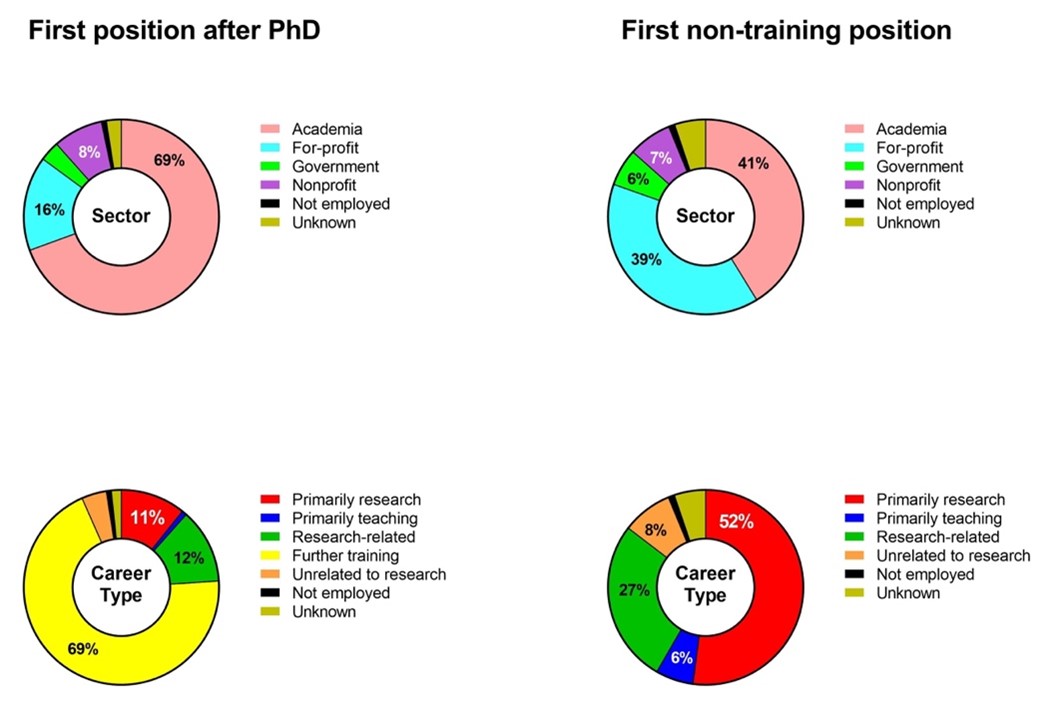
A general overview of the career outcomes for our trainees is provided in the figure below (data are from 2014-2024, based on 121 graduates). As can be seen, the large majority of our trainees continue on in research as postdoctoral fellows (69%). Once in their first non-training position, most remain in research (52%) or research-related (27%) careers. We also find that 41% end up with a career in academia. In sum, the training outcomes of the NGP reflect a robust and evolving program that not only prepares students for successful, independent research careers but also fosters innovation, leadership, and scholarly excellence.
Students holding degrees in the biological or physical sciences, psychology, or biomedical engineering are especially encouraged to apply to the Neuroscience Ph.D. Program, but applicants from other fields will be considered.
Grants and Awards
All students in good academic standing will have their tuition and stipend provided. There are several sources for these funds, including training grants, awards and teaching assistantships. In addition, exceptional students with outstanding accomplishments can be nominated for that can supplement their stipend up to $10,000; for example, the Provost’s Graduate Fellowship Award, the University Graduate Fellowship Award, and the Harold Stirling Vanderbilt Graduate Scholarship.
Training in Fundamental Neuroscience T32 Grant
The Neuroscience Graduate Program receives invaluable support from the "Training in Fundamental Neuroscience" NIH T32. Over 70 mentors across 23 departments within 5 schools and colleges are available to train students, with 65+ Neuroscience trainees earning PhDs in the past 5 years. Over 60 trainees have been supported by the T32 since its inception, with over a third subsequently securing their own fellowship funding.
Graduate students interested in joining the training program should contact Dr. Bruce Carter, Associate Director for Education & Training and Director of Graduate Studies for the VBI.
Faculty interested in becoming T32 preceptors should contact Dr. Bruce Carter or Dr. Lisa Monteggia, VBI Director.
Cellular & Molecular Application Tip
Students with broad biomedical interests are encouraged to apply through the Interdisciplinary Graduate Program in Biological and Biomedical Sciences instead of directly through the Neuroscience Ph.D. Program. This pathways provides a strong foundation in biomedical science prior to matriculation into neuroscience.
Students begin their first year with a general course in graduate level cellular and molecular biology and then begin specialized courses in Neuroscience in the spring semester of their first year.