
Protectors of the Past
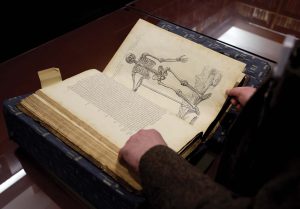
When Vanderbilt University archivist Jim Thweatt slips a massive tome from a shelf and gently opens its pages, it’s as if a portal to the past has magically flung open and history cascades out.
The elaborately illustrated “De Humani Corporis Fabrica Libri Septem” (“On the Fabric of the Human Body in Seven Books”) is one of the most historically significant works on human anatomy of all time.
First published in 1543 by Renaissance physician Andreas Vesalius, meticulous text on all that was known or believed about the human body, and detailed, cutaway illustrations of anatomy based on Vesalius’ human dissections made the book a must-have reference for 16th century physicians throughout Europe.
Fewer than 400 copies of the book remain, and the one admired by Thweatt is part of the History of Medicine Collections and Archives housed at the Annette and Irwin Eskind Family Biomedical Library and Learning Center. It is a second edition, published in 1555, donated to the library by Crawford Adams, MD, a prominent Vanderbilt University Medical Center cardiologist and bibliophile.
It is just one of the approximately 15,000 volumes and books; 2,000 artifacts; and hundreds of manuscripts, photographs and other materials illuminating the story of medicine that make up the collections and archives preserved by Thweatt and curator Chris Ryland.
Preserving the history of medicine provides context about how treatments and diagnoses have evolved, records the contributions of key figures in medicine through the years, and potentially informs future advances in health care.
“Even today, in modern textbooks there will be vestiges from the distant past. It’s less visible, but it’s there,” said Thweatt. “The primary concern has always been to heal and help people. It’s very important, especially for students, to gain that perspective — that medicine is an evolving process. Here are the foundations, and you are part of that progression.”
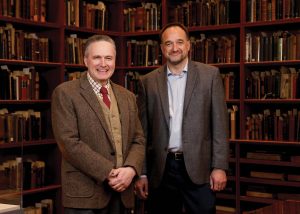
The most visible portion of the collections is found in a stately room lined with cherry bookcases stretching to the ceiling, with protective cases and cabinets sheltering the most fragile and rare treasures. Large tables give researchers room to work, and a cozy seating area is a favored escape for many noted faculty. During the 2017-2018 renovation of the library, the Eskind family specifically asked that this pleasant room not be touched.
The library’s protective basement vault houses what Ryland jokes are the “medium rare” collections, with a wealth of boxes packed with artifacts — think early surgical instruments, microscopes, syringes, beakers and stethoscopes — as well as shelves filled with documents. A back wall is hung with framed treasures such as composite photos of medical school graduates and faculty from the 1800s on and intricate medical illustrations meant to demystify various scourges and maladies.
Many more items are safely stored, awaiting sorting and cataloging to join the official collections. As alumni and others donate items, it seems Ryland’s and Thweatt’s jobs will be never-ending, which is a matter of great joy for them.
“I’ve been very lucky to do something like this that I love,” Ryland said. “I’m surrounded every day by all these books filled with voices from the past, and all of them have something important to offer us, often in ways we never expected.
“Plus, our visitors and researchers are all experts in their own areas, and what I learn from them I can use to help the next professor teaching a class, or the next scholar looking for that perfect source.”
These extraordinary collections, dating from around 1500, are open to all curious souls — researchers and students at VU, VUMC and the public — to view by appointment.
Ryland’s love of antiquities, particularly rare and antique books, was ignited when he moved to Nashville after graduating from Maryville College in East Tennessee. He landed a job at a book collectors’ mecca, Elder’s Bookstore, which opened in 1930. Ryland then got a job at Eskind Biomedical Library, which at that time was a part of the Medical Center.
This led to him attending the University of Tennessee, Knoxville, for a master’s degree in information sciences. After working in the corporate world for a bit, Ryland returned to Nashville, and he again was hired at Eskind Biomedical Library.
After expressing interest in archives and special collections, he began spending more time in this area. When Special Collections librarian Mary Teloh retired after 38 years, Ryland soon moved into the role of curator of the History of Medicine Collections and Archives.
In 2016, when VU and VUMC legally separated, Ryland and Thweatt became employees of Vanderbilt’s Jean and Alexander Heard Libraries. In 2024 the History of Medicine Collections formally became a part of the Vanderbilt Special Collections.
After graduating from Austin Peay State University with a degree in history and English, Thweatt came by his archivist role in a less traditional way. His father, John Thweatt, was an archivist at the Tennessee State Library and Archives in Nashville. The younger Thweatt has fond memories of his family spending time with his father as he worked in the archives on the weekend.
“It was such great fun, just seeing the researchers there doing research and finding things,” he said. “There were some interesting characters! I started attending archivist conferences with my father, and at one of the conferences I became aware of an open position here in 1992. I’ve been here ever since.”
A curated selection of the History of Medicine Collections’ photos, documents and artifacts can be viewed at the Annette and Irwin Eskind Family Biomedical Library and Learning Center in a special exhibit, “United in Purpose: 150 Years of Medicine and Nursing at Vanderbilt.” The exhibit is in observance of the sesquicentennial of Vanderbilt University and its School of Medicine.
The History of Medicine Collections and Archives are a unit of Vanderbilt Special Collections and University Archives. The collections can be viewed by appointment only, 8 a.m.-5 p.m., Monday through Friday. Visit www.library.vanderbilt.edu/specialcollections/historyofmedicinecollections.