
The man who gave Angel 1 its wings
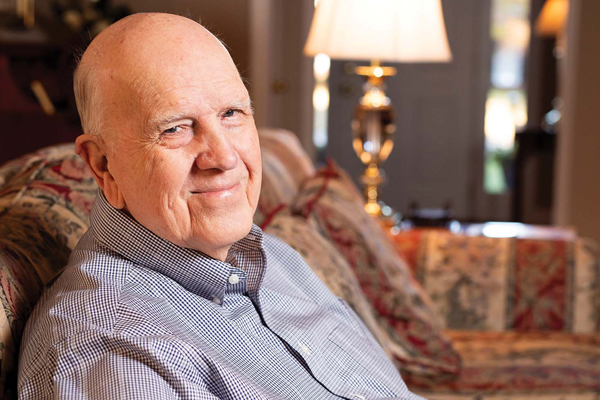
In 1954, shortly after he completed his year of ground control radar training at Keesler Air Force Base in Biloxi, Mississippi, Curtis “Dean” Driver was transferred to Châteauroux, France: It was his first assignment, and he’d never been on a site with working instruments.
Two weeks later, he was unexpectedly promoted to station chief, which meant maintaining the whole radar site.
Driver was surprised but not overwhelmed. He trusted himself to figure it out, and he did.
Driver didn’t plan to spend his career in ground control radar: He took radio and TV engineering courses through the Air Force training program, and when he finished his tour and returned to Nashville, the Tennessee native enrolled in a two-year course at Mid-South Electronics with a plan to be a chief engineer at a radio and TV conglomerate.
One of his teachers, Tom Arnold, asked if he’d be interested in the medical side of electronics instead and offered him a position as a support medical electronic technician in Vanderbilt University’s Department of Medicine. Driver accepted and started in 1959.
Together with Arnold and another employee, Driver helped develop catheterization systems and the first large-screen TVs used for medicine. Driver’s responsibilities grew quickly from the Department of Medicine to include other departments within Vanderbilt University Medical Center’s campus.
He was the director of Biomedical Engineering the day Mildred Stahlman, MD, professor of Pediatrics and Pathology, Microbiology and Immunology who established at Vanderbilt the nation’s first neonatal intensive care unit, mentioned in a meeting that she was having a hard time finding someone to build a pediatric transport system.
“I told her, ‘I’ll throw my hat in the ring to build it for you if you’re interested.’ When she got her jaw up off the floor she said, ‘Can you do that?’ And I said, ‘Sure, I can do that,’” said Driver, who had never done anything like this project. “She and Dr. Angela Skelton had gone round and round trying to find someone, and it tickled them to death that someone close by could make it happen. One day she called and said, ‘Start building.’”
At the time, the NICU lost a tremendous number of premature babies due to hyaline membrane disease, also known as respiratory distress syndrome, a condition that occurs due to a lack of surfactant, a substance made by the lungs around 26 weeks of pregnancy. It keeps the airways open and allows babies to breathe after delivery. Medical providers needed to be able to get to these infants quickly and administer oxygen or perform emergency surgery on the way to the hospital — and ambulances outfitted for neonatal patients didn’t exist at the time.
“I started drawing it out with Dr. Stahlman,” said Driver. “She and I worked really well together, and she helped me with some of the medical applications.”
Driver bought a new panel truck, also called a step van, from Jim Reed Chevrolet in Nashville and had the auto dealer reinforce the suspension so it could handle the weight of the machines and equipment he planned to install. This vehicle has often been referred to as a converted bread truck over the years, but Driver said that’s not the case.
“People call it a bread truck, but it was a brand-new panel truck,” he said. “It looked like a bread truck, but it wasn’t.”
Though it was mobile, the truck had to serve as a stationary hospital with areas for a surgeon and at least two nurses to work and sit. It needed incubators, a surgical space, places to store gases to power machines plus a hot and cold water supply and sewage system, supply storage and a generator — all within an extremely limited space.
The project was considered outside the scope of Driver’s job, so he parked the van at his house and worked on it in his driveway after hours and on weekends.
“I felt the need was important enough to invest the time,” he said.
When it was time for detailing and touch-up work, Driver reached out to Haynes Sloan, a friend and local sign shop owner who had done work for him on other projects. That’s when Driver had an idea that would affect a fleet of Vanderbilt pediatric transports for decades to come.
“In the process of figuring out what to put on the side of the van, it came to me that it ought to be called Angel 1. How much closer to an angel can you get than a little bitty baby struggling for life?” Driver said. “I took my idea to Haynes, and he drew what he thought was the outline of an angel. We made a few modifications and, lo and behold, there was an angel beside the words Angel 1 above the passenger door. The Lord gets the glory for the angel, not me.”
The blessings continued. While he was in the final stages of preparing Angel 1, which took its first ride in August 1974, Driver learned that the pediatric transport project had received a grant from the State of Tennessee to purchase a two-way radio that tied in to the same frequency as the Vanderbilt medical ambulance system.
Though the first pediatric transport in the region undoubtedly changed the lives of countless families for the better, Driver, who is now 91, heard a story that confirmed its importance years after he left Vanderbilt in 1979.
“My first wife died of cancer, and my second wife, who I’m still married to now, had a baby around the same time as a friend of hers,” he remembered. “That friend’s baby was sick, and the neonatal van at Vanderbilt went up to Sumner County Hospital in Gallatin and brought it back to Vanderbilt,” Driver said. “Unfortunately, the baby was lost, but it was nice that it had every chance it could.”