Types of Services
The Vanderbilt HTS Facility provides various services to the research community. Consultations are available for assay design, optimization, development, and validation, as well as for integrating automated HTS and data analysis. To contact HTS staff to discuss specific needs, please log in with your institution’s iLab account and complete a Project Request Form. Staff will evaluate requests and provide information describing the suggested resources required.
Access & Reservations
Instrument reservations and access requests are managed through the Agilent iLab Operations Software. Detailed guidance is available in the User Instructions.
Facilities
- Hoods (BSC) are reservable through HTS iLab
- Thermo Multidrop Combi in hood for fast, high-throughput cell plating or liquid dispensing
- Agilent Bravo for full plate (96w or 384w) liquid handling-note: can also do partial plate and single well cherry-pick
- CO2 incubator for cell incubations- short or long-term growth
- Cell counter (Countess)
- Access to 4°/-20° storage and water bath (37°)
- Large vessel flask and plates
~2,000 sq ft office/lab space
Plate Readers
-
Automated Panoptic Kinetic Imaging Plate Reader
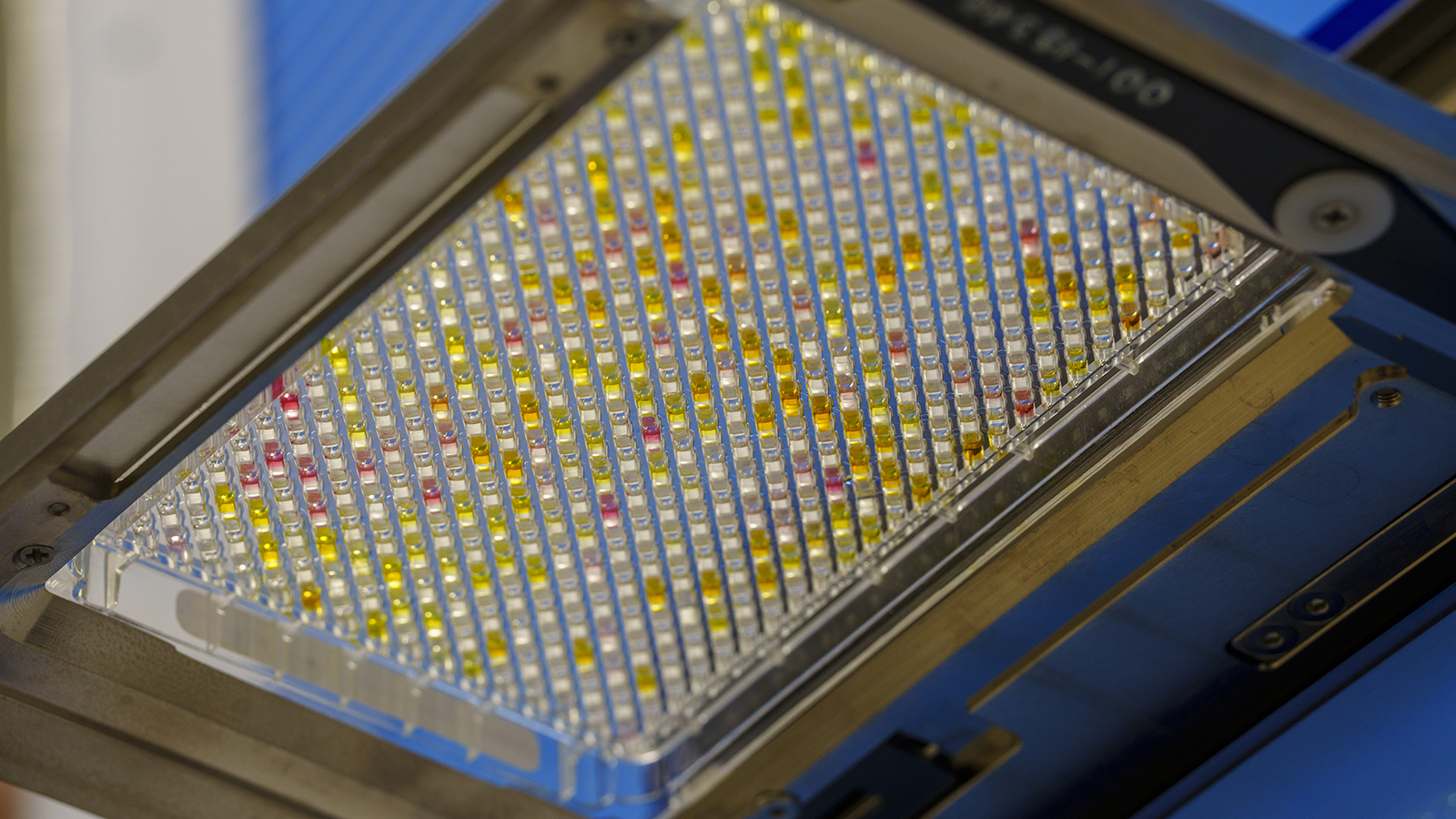
 The WaveFront Panoptic is a highly advanced kinetic whole plate imager equipped with built-in 96/384-channel liquid handling robotics and up to nine plate holder nests. This automated system is capable of measuring fluorescence and/or luminescence, simultaneously from all wells of a microplate. When the Panoptic is integrated with a BioTek plate washer, Thermo Multidrop Combi, Thermo Cytomat, Spinnaker microplate mover and Waveguide data acquisition software, it serves as an efficient and versatile automation platform for HTS and early phase drug discovery efforts (see below image).
HTS core offers comprehensive screening-based services for all stages of the drug discovery process using our WaveFront Panoptic. We provide instrument training, compound management, assay development, assistance with data analysis, and post-screen hit validation (dose dependence), among other services. Please reference HTS core and the NIH Shared Instrumentation Grant 1S10OD021734 when publishing papers that utilized the Panoptic Kinetic Imaging Plate Reader.
Features & Capabilities
Optics
Thermoelectrically cooled (TEC) highly sensitive CCD camera
-10 excitation, 5 emission and rapid-changing filters
-30 Hz continuous acquisition
-> 10000 hour broadband illumination
-Field flatness > 99.7%
-Distortion < 0.05%Liquid Handling
Infrared SpyBall camera for real-time monitoring the liquid handling
- Nine, user-configurable, nest positions
-Can accommodate 3 separate tip boxes for ‘triple addition’ screening protocol
-Automated tip exchange
-Temperature control: ambient to 42 degreeSoftware
-Waveguide software
-Powerful and flexible
-Real-time data view
-Built-in data normalizationApplications and Targets
Fluorescence
- Calcium Flux assay (GPCRs)
- Thallium Flux assay (K+ channels, Na+ channels)
- Membrane potential (Ion channels, neurontransmitter transporters)
- Nucleotide exchange assay (K-RAS)
- FRET (Kinase activity)Luminescence
- cAMP-Glo assay (GPCRs)
- Luciferase Reporter assay (transcription factors)
- BRET (bioluminescence resonance energy transfer) assay (protein-protein interaction)Filter Sets

Instrument Training
Please contract Dehui Mi and Liangping Li to discuss assay parameters/conditions if needed.
**NIH S10 acknowledgment required - view citation
-
BioTek Synergy Neo2 Hybrid Multimode Reader
 BioTek Synergy Neo2 multimode microplate reader features patented Hybrid Technology (filter-based and monochromator), with independent optical paths that ensure excellent performance in all detection modes. Variable bandwidth quad monochromators, sensitive high transmission filter-based optics, laser TRF, and up to 4 PMTs provide ultrafast measurements for clinical diagnostic applications.
Features and Capabilities of the NEO2
Modes:
- Absorbance/optical density (colorimetric)
- Fluorescence (filter or mono)
- Luminescence (very low crossover)
- Time-resolved fluorescence and TR-FRET
- Fluorescence Polarization (filters only)
- AlphaScreen (filters only)
Microplates
- Capable of scanning 96, 384, or 1536-well microplates.
- Can image an entire 384-well plate with multiple fluorescent images in a few minutes.

-
BioTek Cytation 5 Cell Imaging Multimode Reader
 Cytation 5 cell imaging reader combines automated microscopy and conventional microplate detection in a configurable, upgradable platform. The microscopy module offers up to 60x magnification in fluorescence, brightfield, high contrast brightfield, color brightfield, and phase contrast to address many applications and workflows.
The multimode detection modules include filter- and monochromator-based fluorescence detection, luminescence, and UV-Vis absorbance detection. Gen5 software provides complete control over all imaging and data capture, plus powerful image and data analysis.
Features & Capabilities
- Modular, upgradable imaging modes, plus multimode detection enables a range of cell-based assays and applications beyond a standard microplate reader
- Combination of hybrid plate reader and advanced microscopy mode increases productivity for a system that is ready for any assay
- Hit-picking capability reduces time and computer memory with no unnecessary data collection or analysis
- Fully automated microscopy tasks, from slide scanning to time-lapse live cell assays, and flexible hardware increase productivity and reduce manual labor
- Combination of monochromator and filter optics delivers flexibility and performance to microplate assays, and choice of optics allows you to read microplates in a wide range of applications
- BioTek Gen5 software enables walk-away automation for your image process and analysis workflows and data analysis tasks
- Variable bandwidth quad monochromator optics enhance assay performance including increased sensitivity and lower limits of detection
Microplates & Slides
- Capable of scanning a 96-, 384, or 1536-well microplates.
- Cell culture flasks (T25)
- Can image an entire 384-well plate with multiple fluorescent images in a few minutes.

Training and Reservations
To use the Cytation 5, please submit a Training Request Form in iLab. *Only trained users and staff can create reservations.
View the iLab reservation calendar through your iLab portal.
Publications
Please include the following in any publication:
“The Integrated Automated Liquid Handling System for Novel Antibody Discovery is housed and managed within the Vanderbilt High-Throughput Screening Core Facility, an institutionally supported core, and was funded by NIH Shared Instrumentation Grant S10OD021737”
High Content Screening/Imaging Capabilities
The HTS Core Lab, supported by an NIH S10 Shared Instrumentation Grant, features fully automated Molecular Devices ImageXpress Confocal HT.ai and ImageXpress Micro XLS systems for unattended live or fixed sample imaging (confocal, widefield fluorescence, and transmitted light).
We provide two analysis workstations plus one remote-access workstation with MetaXpress and IN Carta software for advanced image analysis. Both systems offer flexible lasers, filters, and objectives; detailed specs and resolution calculators are available.
*NIH S10 acknowledgment required - view citation
-
ImageXpress Confocal HT.ai (Molecular Devices)

- Sample format flexibility
- Wide-field CMOS camera
- Standard and deep tissue confocal capabilities
- 4x, 10x, 20x, 40x + water immersion objectives
- 8 laser system w/up to 6 non-overlapping fluorescent channels
- 6- to 1536-well plates
- High-speed laser and image-based autofocus
- Solid state light source for transmitted light imaging
- Automation friendly
- Environmental controls- CO2, heat, humidity, chiller
Filter Sets

-
ImageXpress Micro XLS (Molecular Devices)

- Sample format flexibility
- Wide-field CMOS camera
- 4x, 10x, 20x, 40x objectives
- 5 fluorescent filter sets
- Transmitted light (w/phase contrast)
- Compatible for 6- to 1536-well plates
- High-speed laser and image-based autofocus
- Solid state light source
- Automation friendly
Filter Sets

-
Fully automated live or fixed-sample imaging

- Fully automated tissue culture incubator and ambient temperature storage for unattended imaging of live and/or fixed samples.
- Integrated barcode scanner for tracking and merging sample information and data.
- Green Button Go scheduling software for orchestration of fully automated, unattended imaging sessions.
-
IN Carta and MetaXpress Image Analysis Workstations, 2 options:

1.A MetaXpress Offline analysis computer workstation is available to review and analyze images acquired on the ImageXpress systems (confocal and/or widefield).
- MetaXpress software offers a variety of standard analysis options as well as a custom module editor for more sophisticated image processing and analyses.
2. An IN Carta analysis computer workstation is available to review images and analyze images using the AI/ML (Artificial Intelligence/Machine Learning) based tools within IN Carta:
- SINAP (Segmentation Is Not A Problem): Deep learning based image segmentation.
- Phenoglyphs: Supervised and unsupervised ML based phenotypic classification.
- 2D, 3D and 4D (time series) analyses of more complex biological model systems such as organoids, spheroids and whole animals.
- MetaXpress Custom Module editor embedded for unparalleled image processing and analysis flexibility.
For imaging using the Cytation5 within CASSy, please see information above.
Seahorse (Extracellular Flux Analyzer) Instruments
-
Xfe 96 Analyzer

- Mature technology from 2012
- High Throughput
- Economical
- Up to 24 Groups
- Good Error
- Good Sensitivity
- Good for Spheroids / Small Organisms
*NIH S10 acknowledgment required - view citation
-
XF Pro Analyzer

- Most Advanced
- Advanced Thermal Control
- Edge Effect Reduction
- Compatible with Cutting Edge Applications
- Certified/QC Assurance
- High Sensitivity
- High Throughput
- Most Economical
- Up to 80 groups/ Fewer Replicates
- Tight Error
- Good for Spheroids/ Small organisms
- Projects Compatible
*NIH S10 acknowledgment required - view citation
- Most Advanced
-
XF HS Mini Analyzer

- Highest Sensitivity
- Easier to Set Up Experiments
- Good for Rare Samples
Liquid Handling (non-contact)
-
Labcyte Echo OMICS 555
 The Labcyte Echo OMICS 555 is a high-throughput, acoustic liquid handler leveraging non-contact Acoustic Droplet Ejection (ADE) technology to deliver precise 2.5nL- scale transfers.
The system is controlled using Echo Client, Echo Cherry-Pick and Echo Dose-Response software. It also supports method simulation, protocol recovery and logs full audit trails.
Installed in February 2013, this machine supports seamless plate-to-plate dispensing, real time fluid composition monitoring, and reduces tip-related waste all while enabling true high-throughput workflows.
-
Beckman Echo 650
 The Beckman Echo 650 is a versatile acoustic liquid handler delivering contact-free, nanoliter-scale transfers using Acoustic Droplet Ejection (ADE) technology.
Building on the proven precision of the Echo platform, the 650 introduces multi-solvent transfers in a single protocol, supporting even more complex assays. The system is controlled using Echo Client Utility, Echo Plate Reformat, Echo Cherry-Pick and Echo Dose-Response software. It also supports method simulation, protocol recovery and logs full audit trails.
Installed in March 2022, the Echo 650 expanded the Vanderbilt HTS Core's capacity for even more seamless plate-to-plate dispensing, real time fluid composition monitoring, and reduced tip-related waste.
-
Revvity FlexDrop iQ Non-contact Dispenser
 The FlexDrop™ iQ Non-Contact Dispenser is perfect simple, very small volume dispensing workflows and can be set-up and used in minutes.
Features and Capabilities of the Revvity FlexDrop iQ.
- Make, optimize & dispense a wide range of liquid classes, incl DMSO
- Low volume to high volume range (8 nL-80 µL) allows compounds & buffer backfilling on the same instrument
- Wide range of sample types, large & small molecules
- Precision less than 5%CV at 50 nL volume (H2O)
- Fast and efficient: dispense 10 nL into 96 wells in 10 seconds, into 384 wells in 20 seconds. unique speed at high volumes
Training and Reservations
To use the Revvity FlexDrop, please submit a Training Request Form in iLab. *Only trained users and staff can create reservations.
View the iLab reservation calendar through your iLab portal.
*Consumables available for purchase through iLab
Publications
Please include the following in any publication "The Revvity FlexDrop iQ Non-contact Dispenser is housed and managed within the Vanderbilt High-Throughput Screening Core Facility, an institutionally supported core.“
Liquid handling (tip-based)
-
Bravo Automated Liquid Handling Platform
 The Agilent Bravo is a flexible liquid handling platform that automates your sample preparation for screening applications such as compound management, cell-based assays, and genomic assays. With this robotic liquid handling system, time is freed up and consistent data are achieved across samples and users.
The compact liquid handler can be easily placed on a small bench and fits in a flow hood. With more than 60 accessories ranging from thermal cycler to shaker, the system can be tailored to automate most sample preparation protocols. Automating your sample prep protocol has never been easier with the included VWorks control software that allows users to create and run flexible liquid handling protocols quickly.
Features and Capabilities
- Compact, space-saving nine microplate-position footprint fits in a laminar flow hood
- Precise pipette heads dispense from 300 nL to 250 µL in 96-, 384-, and 1536- microplates using disposable tips
- Versatile 96 and 384 pipette heads can easily be swapped to address your needs
- Unique open design permits access from all sides for improved user interaction
- Provides ability to pick up tips using a single barrel, row, column, or arrays of barrels
- VWorks control software helps you to quickly create automated protocols by using the intuitive drag and drop tasks
Training and Reservations
To use the Agilent Bravo, please submit a Training Request Form in iLab. *Only trained users and staff can create reservations.
We have three Agilent Bravo instruments, in addition to the Bravos in the Panoptic instruments. View the iLab reservation calendars through your iLab portal.
Publications
Please include the following in any publication:
"The Agilent Bravo Liquid Handling Platform is housed and managed within the Vanderbilt High-Throughput Screening Core Facility, an institutionally supported core.“
-
VIAFLO 96 | VIAFLO 384, 96- and 384-channel handheld electronic pipettes
 VIAFLO 96 | VIAFLO 384 is a compact, and easy to use pipette which greatly increases productivity and throughput.
We have both a 96-channel head and a 384-channel head in varying volume ranges (0.5 to 1250 ul) and number of channels (96, or 384 channels), VIAFLOs can handle a wide range of applications and volumes. These instruments offer flexibility by allowing filling plates either by hand or by using the hands-free automatic mode.
Features and Capabilities
Reservoir-to-plate transfers
- Compound addition
- Medium exchange
- Cell seeding
- Addition of buffers and reagents
Plate-to-plate transfers
- Plate duplication
- Supernatant transfers/collections
- Plate reformatting
Sample transfers within plates
- Serial dilutions
- Mixing and resuspension
Magnetic bead purifications with MAG modules
- PCR, NGS library clean-ups
- DNA/RNA extraction
Training and Reservations
To use the Integra VIAFLO 384, please submit a Training Request Form in iLab. *Only trained users and staff can create reservations.
View the iLab reservation calendar through your iLab portal.
Stocked Consumables:
- Integra 6463 - 125 µL NS (each) VIAFLOW 384 - Non-Sterile
- Integra 6564 - 125 µL S-LR (each) VIAFLOW 384 - Sterile, Low-retention, Unfiltered
Publications
Please include the following in any publication:
"The VIAFLO 384 Liquid Handling Platform is housed and managed within the Vanderbilt High-Throughput Screening Core Facility, an institutionally supported core.“
Liquid handling (plate washer)
-
Agilent BioTek 405 TS/LS Microplate Washer
 The Agilent BioTek 405 TS/LS microplate washer is well known for its gold-standard performance in life science research. Experience higher throughput and reduced assay variability thanks to its unique features and advanced technologies.
- Versatile: Ideal for everything from cell-based assays to ELISAs.
- Intuitive: Easy-to-use touchscreen interface.
- Reliable: Self-maintaining design for consistent operation.
- Automate: Fully compatible with automation systems.
Features and Capabilities
Additional Applications:
- Drug discovery and development ADME Assays
- ELISA
- ELISpot assays
- Immunology
- Virology

Training and Reservations
To use the Agilent BioTek 405 TS/LS Plate Washer, please submit a Training Request Form in iLab. *Only trained users and staff can create reservations.
View the iLab reservation calendars through your iLab portal.
Publications
Please include the following in any publication:
"The Agilent BioTek 405 TS/LS Plate Washer is housed and managed within the Vanderbilt High-Throughput Screening Core Facility, an institutionally supported core.“
Liquid handling (bulk dispenser)
-
ThermoFisher Multidrop Combi Reagent Dispenser
 Built for high-throughput labs, Multidrop dispensers rapidly process plates with exceptional consistency—dispensing a 384-well plate in just 6 seconds and a 1536-well plate in only 15 seconds.
These flexible, non-contact dispensers streamline workflows, minimize reagent waste, and keep pace with demanding screening and assay protocols. Whether you're accelerating qPCR setup or scaling drug discovery efforts, Multidrop dispensers deliver fast, reliable performance
Features and Capabilities
- Applications:
- Assay development
- Cell-based assays
- ELISA
- Genomic and Proteomic Research
- Compound Storage
- Primary and Secondary Screening
- Wide Volume Range: 0.5 to 2,500 µL
- Providing precise and reproducible results across different applications, from small-scale experiments to large-scale assays.
- Compatibility with Various Plate Types: 6- to 1536-well plates
- Offering versatility for different laboratory setups and ensuring that the device meets various experimental needs.
- Simple Operation with Intuitive Interface:
- The visual, icon-based graphic display simplifies programming and use, reducing the need for extensive
- training and enabling quick setup and operation.
- Reduced Reagent Costs:
- Feature low dead volume and backflushing capabilities, which minimize reagent waste and reduce costs.
- Full Robotic Compatibility:
- Facilitates integration into automated workflows, increasing throughput and efficiency in high-demand laboratory environments.
Specifications
•User Interface
On-board interface or FILLit PC software
•Volume
0.5-2500 µl
•Volume increments
Small tube dispensing cassette: 0.5–50 μL, in 0.5 μL increments
Standard tube dispensing cassette: 5- 2,000 µL in 5 µL increments
•Dispensing technology
Peristaltic pump
•Dispensing volume adjustability
Per column
•Dead Volume
< 1 mL volume range: 0.5 - 50 µL
<7 mL volume range: >50 µL
(it is possible to backflush the reagent into original reservoir to avoid loss of expensive reagent)
•Plate Format
9- to 1,536-well plates: including 96- and 384-deep well and tubes in rack format (plate height: 5 - 50 mm)
•Automation/robot compatible
Yes
Training and Reservations
To use the ThermoFisher Multidrop Combi Reagent Dispenser, please submit a Training Request Form in iLab. *Only trained users and staff can create reservations.
View the iLab reservation calendars through your iLab portal. *Needed only if in a tissue culture hood.
Publications
Please include the following in any publication:
"The ThermoFisher Multidrop Combi Reagent Dispenser is housed and managed within the Vanderbilt High-Throughput Screening Core Facility, an institutionally supported core.“
Tip Washer
-
Grenova TipNovus Gen5
 HTS Core recently upgraded to the Grenova TipNovus Gen5 tip washer. This unit is designed to extend the life of reusable 30uL Agilent Bravo tips by providing a fast, reliable cleaning process. Accommodating up to four racks of tips per wash cycle, it delivers high-throughput tip washing to support demanding screening workflow. As part of our tip washing service, we collect, clean, inspect, and return tips to our stockroom for reuse, helping you significantly reduce consumables costs without compromising performance. By incorporating washed tips into your workflow, labs can lower operating expenses, reduce plastic waste, and support more sustainable research practices.
HTS Core strives to maintain a stock of washed tips for users, however, if you need a large number of washed tips, please contact Sydnee Elmore to make arrangements ahead of time.
Compound Management
-
Hamilton Verso M2
 The Hamilton Verso M2 is a high-throughput, −20 °C automated storage system precisely configured for Thermo Matrix 0.7 mL tubes and 384‑well plates. Equipped with a Universal Tube Picker, it delivers rapid, accurate, and automated single‑tube retrieval while preserving sample integrity. Capable of processing up to 1,500 tubes per hour and 170 plates per hour, the system uses the INSTINCT S software and benefit from a simple 3‑click interface plus LIMS and robotic integration, complete audit trails, and overnight unattended operation. Rack loading is streamlined via a foot‑activated I/O door supporting up to 100 racks. The Verso M2 installation was completed in March 2024 and is an essential platform for our high-throughput screening infrastructure providing a long-term storage environment, rapid retrieval, and tracking mechanism for each compound.
*NIH S10 acknowledgment required - view citation
-
Zinsser Analytic Alli liquid handler
 The Zinsser Analytic Alli Automated Liquid Handling System is a fully customizable, modular, robotics‑driven platform offering flexibility and precision in sample preparation workflows. The Alli has 4 independent dispensing self-cleaning tips (5 µL to 1 mL), advanced liquid‑level detection, barcode scanning and verification, vortex with lids, it handles both DMSO and d6-DMSO interchangeably. It's main functions are for compound dissolutions and tube-to-plate reformatting. The system is controlled via intuitive WinLissy® software for complex protocols including fully automated liquid‑liquid extraction with real‑time conductivity feedback for precise liquid transfers. It also supports method simulation and protocol recovery and logs full audit trails. The Zinsser Alli was installed in July 2023 and is a robust platform for high-demand of compound distributions.
Automation
*The HTS facility manages projects and billing through iLab.