


Design, Synthesis, and Capabilities
The Molecular Design and Synthesis Center (MDSC) provides consultation and support in all aspects of small molecule design and synthesis. Scope of work ranges from single compound synthesis (milligram up to 100g scale ), hit prioritization following screening (in collaboration with the VICB High-Throughput Screening facility), lead optimization, and scale-up for in vivo Proof-of-Concept (POC) Studies. The MDSC has also supported chemical biology studies such as target identification and assay development by designing and synthesizing novel chemical probes. Specific examples are provided below.
Chemical Probes for Proof-of-Concept studies and pre-clincal development
-
Typical workflow for lead discovery and development.
Basic research is an essential foundation for translational studies that can ultimately yield new therapeutic approaches. This work often depends on the creation of small-molecule chemical probes that modulate specific biological pathways, enabling investigators to test hypotheses with potential relevance to disease treatment.In vivo validation or proof-of-concept studies generally require a high-quality probe, which not only must exhibit strong potency and selectivity (see earlier sections), but also appropriate Drug Metabolism and Pharmacokinetic (DMPK) properties so that it can reach the intended site of action in animal models. In some cases, successful target validation using such a probe justifies a broader drug discovery effort, with the probe serving as a lead compound for further optimization. The discovery of lead molecules is inherently collaborative, involving chemists, pharmacologists, and individual PIs. The generalized workflow that emphasizes the collaborative interactions between a PI’s laboratory and the MDSC and HTSC cores is illustrated in the figure below.
-
NIH and NCI Research Collaborations
Since their founding in 2007, the MDSC and HTS cores have supported chemical probe and pre-clinical lead discovery and development, efforts that initiated with their participation in the NIH Molecular Library Screening Center Network and the NCI Chemical Biology Consortium. Here are examples of small molecules developed at Vanderbilt with support from HTSC and/or MDSC.
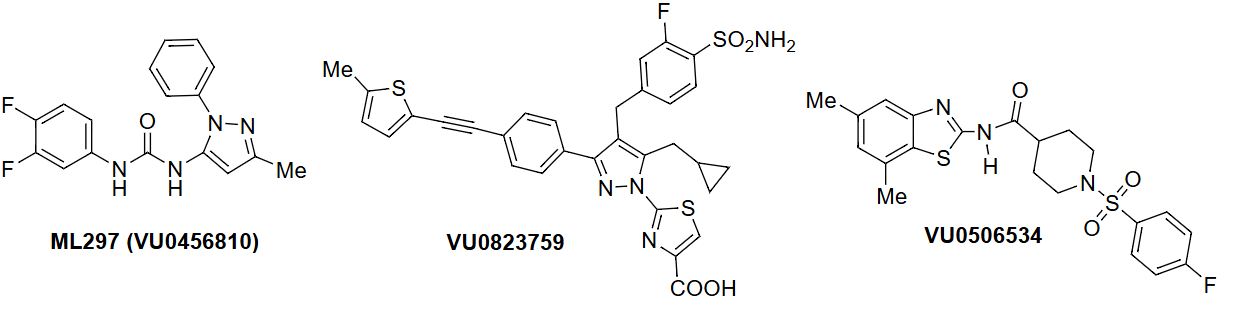
ML297 (VU0456810) GIRK Channel activator (DOI:10.1021/cn400062a); VU0823759 LDHA inhibitor (DOI:10.1021/acs.jmedchem.0c00916); VU0506534 NAPE-PLD activator (DOI:10.1021/acschembio.3c00401)
-
Chemical probe design and synthesis for interrogating biology
A variety of creative assays and techniques have been developed that employ affinity and/or fluorescent probes to interrogate biological processes in real time using a spectrum of systems that range from biochemical and single cell assays up to and including whole organism models. Several examples of chemical probes developed and/or provided by MDSC are are illustrated in the following figure below.
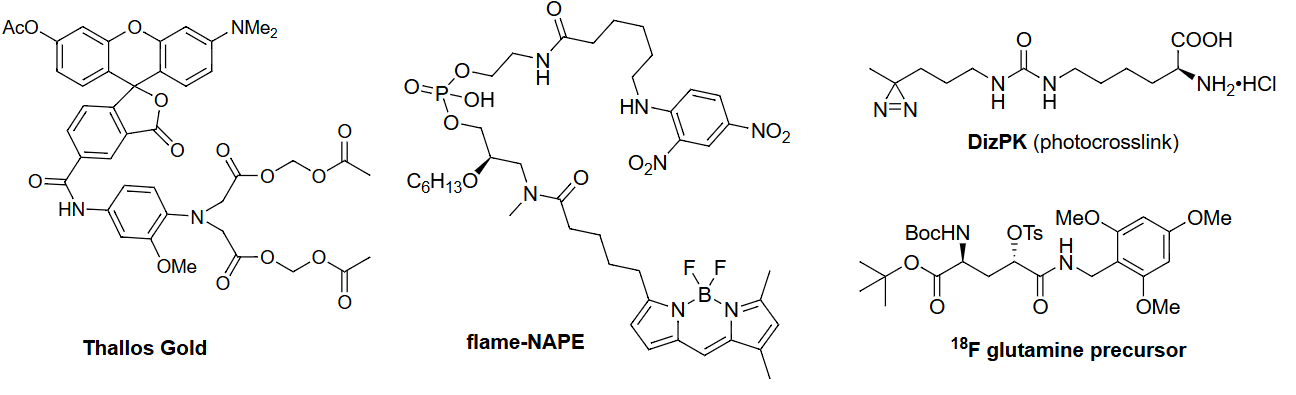
Thallos Gold: monitor potassium ion channels (DOI:10.1039/c8ob01098f); flame-NAPE selectively monitor NAPE-PLD activity over esterases (DOI:10.1016/j.jlr.2021.100156); DizPK photo crosslinking amino acid (DOI 10.1038/ncomms12299); 18F glutamine precursor to PET active 18F glutamine
-
Synthesis of Natural products and metabolites
Small molecule natural products, which are identified within living organisms, are of frequent interest to biomedical investigators for study of their function and/or as biomarkers of human disease. Several naturally occurring compounds produced by MDSC are highlighted in in the figure below.
A more comprehensive listing of MDSC compounds available for purchase is provided under Compound Collection.
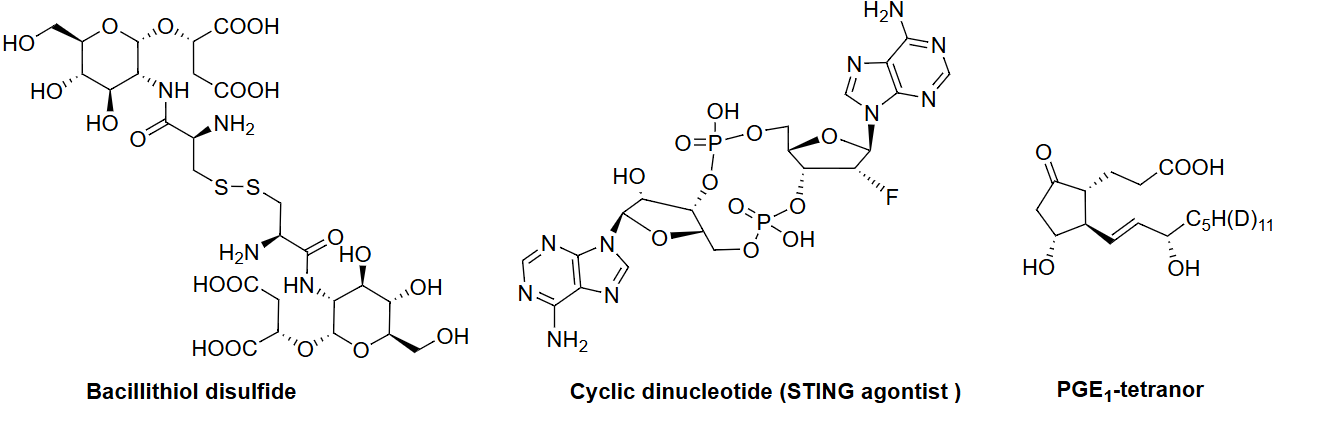
Bacillithiol disulfide: Gram-positive bacterial thiol (DOI: 10.1021/ol302327t); Cyclic dinucleotide STING agonist (DOI:10.1126/sciimmunol.add1153); PGE1 tetranor prostaglandin metabolite.
Facilities
The Molecular Design and Synthesis Core (MDSC) is located on the 12th floor of Medical Research Building IV (MRB IV), with research labs in 12475 and an office suite in 12478. Each staff member is assigned bench space including a 6-foot chemical fume hood, a variety of storage units, refrigerator and desk space. One fume hood is designated for cGMP (current Good Manufacturing Practice) synthesis with dedicated equipments and glassware used specifically for cGMP syntheses. MDSC maintains a quality collection of over 6000 chemicals and building blocks to facilitate lead optimization studies employing principles of medicinal chemistry.
Instruments
-
GENESIS VAC Glovebox System

Genesis glove box is a sealed, inert-atmosphere enclosure for handling air- and moisture-sensitive chemicals and materials. The system maintains very low levels of oxygen and water (typically <1–5 ppm) using continuous purging and/or recirculating purification, allowing safe manipulation of reactive reagents, organometallics, and sensitive intermediates.
-
Parr Shaker Hydrogenator
 A Parr shaker hydrogenator is a bench-scale reactor system for safe and efficient catalytic hydrogenation and related gas–liquid reactions. It uses a sealed reaction bottle mounted on a mechanical shaker to ensure intimate contact between the substrate, catalyst, and hydrogen gas, allowing controlled reductions, deprotections, and other transformations under adjustable pressure and temperature.
 -
Gilson GX-271 liquid handler
 A Gilson GX-271 preparative system is a modular high‑performance liquid chromatography (HPLC) platform for large‑scale purification of compounds. It combines high‑capacity pumps, injection modules, UV/other detectors, and automated fraction collectors to separate and collect target molecules (e.g., peptides, natural products, synthetic intermediates) with precise, reproducible control overflow, gradient, and fractionation.
 -
The Agilent 6125B LC/MS
 The Agilent 6125B LC/MS is a single quadrupole liquid chromatography–mass spectrometry system for routine qualitative and quantitative analysis. It offers reliable mass detection over a broad m/z range, rapid switching between ionization modes, and seamless integration with Agilent LC modules, making it well-suited for reaction monitoring, purity assessment, and identification of small molecules in complex mixtures.
 -
CombiFlash Next Gen 300+
 The Next Gen 300+ is a compact, automated flash chromatography system for rapid purification of synthetic compounds. It offers precise gradient control, high‑sensitivity UV/visible detection, and automated fraction collection, enabling efficient separation and cleanup of reaction mixtures with minimal user intervention. Uses predictive method development built into PeakTrak software to quickly optimize methods based on the target peak rather than doing multiple TLC plates
 -
CombiFlash RF+
 The CombiFlash RF is an automated flash chromatography system for rapid, reliable purification of synthetic compounds. It combines programmable gradients, integrated UV/visible detection, and automated fraction collection to efficiently separate complex reaction mixtures and streamline purification workflows. Operates at flow rates typically between 1 to 200 mL/min (depending on the specific configuration) and pressures up to 150 to 200 psi, making it highly effective for both normal and reversed-phase chromatography.
 -
CombiFalsh ACCQPrep HP150
 The ACCQPrep HP150 is a preparative HPLC system for high-efficiency purification with flow rates up to 150 mL/min and pressures up to 6,000 psi. It features an intuitive touchscreen interface, built-in software for method development and fraction collection, and flexible detection options including UV and optional ELSD. Engineered for reliability and ease of use, the ACCQPrep HP150 streamlines scale-up from analytical to preparative separations in research and production environments.
 -
CombiFlash EZ Prep
 The CombiFlash EZ Prep is a hybrid chromatography system that seamlessly combines flash and preparative HPLC in a single, compact platform. It features an intuitive touchscreen interface, automated method development, and versatile detection options to simplify purification workflows from milligram to gram scale. Designed for flexibility and efficiency, the EZ Prep accelerates compound isolation while reducing manual intervention and method transfer challenges.
 -
The Biotage Initiator+
 The Biotage Initiator+ is a microwave synthesizer designed for fast, reproducible chemical reactions with precise temperature and pressure control. It supports a wide range of reaction types and solvents, enabling efficient method development and scale-up from small discovery-scale to larger preparative runs. With intuitive software and robust safety features, the Initiator+ streamlines workflow in medicinal, organic, and materials chemistry laboratories.
 -
Labconco FreeZone 4.5L Benchtop Lyophilizer
 The Labconco FreeZone 4.5 L Benchtop Lyophilizer is a compact, laboratory-scale freeze dryer designed for efficient moisture removal from small to medium sample volumes. Featuring a 4.5-liter ice capacity, it utilizes the intuitive Lyo-Works OS and a 5" color touchscreen for real-time monitoring of vacuum and temperature levels.
 -
Pacific Ozone generator
 The ozone generator produces ozone (O₃) on demand by passing pure oxygen or ambient air through a high-voltage electrical discharge. It used to conduct chemical reactions such as cleaving carbon-carbon double bonds to form alcohols, aldehydes, ketones, or carboxylic acids depending on the chosen workup.
 -
Liberty Blue 2.0 W/HT12
 The Liberty Blue 2.0 is an automated microwave peptide synthesizer from CEM Corporation that speeds up Solid Phase Peptide Synthesis (SPPS) using specialized microwave heating, achieving reaction cycles of just 4 minutes per amino acid. It also offers high-throughput accessories that allow users to queue up to 12 syntheses.
Please use the acknowledgement below if utilizing the SPPS:
"The CEM Liberty Blue 2.0 is housed and managed within the Vanderbilt Molecular Design and Synthesis Center, an institutionally supported core, and was funded by NIH Shared Instrumentation Grant 1S10OD040170-01."
-
Bruker 400 MHz
 The Bruker 400 MHz is a high-field nuclear magnetic resonance (NMR) spectrometer used for structural analysis of small molecules, biomolecules, and materials. Operating at a proton frequency of 400 MHz, it provides high-resolution 1D and 2D NMR spectra, supporting a wide range of experiments (e.g., proton, carbon, and heteronuclear NMR). The NMR facility provides MDSC staff access to a 400 MHz instrument equipped with a sample changer adjacent to MDSC lab space on the 12th floor of MRB IV. In addition, MDSC staff have access to other state-of-the-art NMR spectroscopic equipment along with expert consultation and collaboration (see: NMR Facility).
Compound Analyses and Structural Elucidation
MDSC offers sample analysis, purification, and structural elucidation on a fee-for-service basis. To request these services, users can either submit a project request or contact the core director.
Pricing & Access
MDSC compounds and services are available to a wide user base under a tiered pricing structure that includes discounts for Vanderbilt researchers, academic rates to non-profit institutions and standard commercial rates for industrial companies.
Please contact Plamen Christov for additional details.
Shipping is available to domestic and most international locations, and includes analytical data.