By Leigh Ann Gardner (MSTP Sr. Grants Manager)
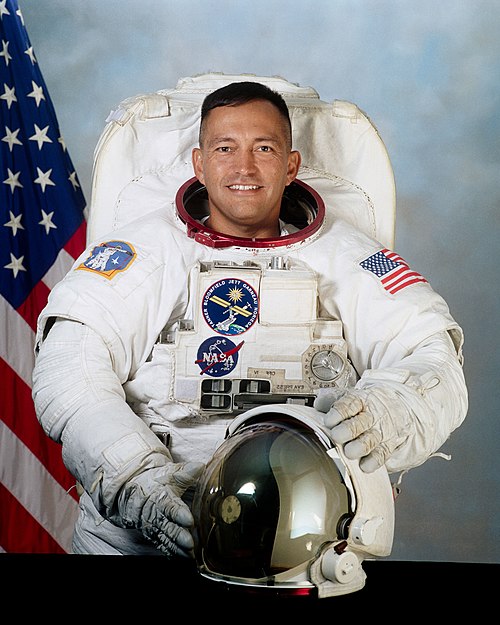
October 8: Born on October 8, 1959, in Lima, Peru, Carlos I. Noriega is the first Peruvian-born astronaut to fly into outer space. He and his family immigrated to the United States when Noriega was five years old, and he graduated from USC with a BS in computer science in 1981 and received MS degrees in computer science and in space systems operations from the Naval Postgraduate School in 1990. A member of the naval ROTC at USC, he received his US Marine Corp commission following graduation from USC. In 1990, he began working at the United States Space Command, and in 1994, he was selected by NASA to train as an astronaut. While at NASA, he flew on the STS-84 (Atlantis) mission in 1997 and on the STS-97 (Endeavor) mission in 2000. He logged more than 481 hours in space during his time with NASA and also trained as a backup commander. He retired from NASA in 2005. You can learn more about his career here and here.
 October 15: On October 15, 2009, Gebisa Ejeta was awarded the World Food Prize for his contribution to the production of sorghum by producing a high-yielding hybrid sorghum plant resistant to drought and Striga. His award noted this contribution enhanced food security for hundreds of millions of people living in sub-Saharan Africa. Born in the village of Wollonkomi, Ethiopia, he attended an agricultural and technical secondary school in Ethiopia and earned his PhD from Purdue University. Following graduation, Ejeta became a sorghum researcher at the International Crop Research Institute for the Semi-Arid Tropics (ICRISAT) branch in Sudan, where he developed the hybrid sorghum plant. He also advocated for farmer education for subsistence farmers and worked to create economic development in the region. Ejeta has also worked to improve crop productivity and increase the value of agricultural products, thus improving life for many farmers in sub-Saharan Africa. Also in 2009, Ejeta was awarded the National Hero Award from Ethiopia, the country’s highest honor. Ejeta received the Mational Medal of Science in 2023. You can learn more about Ejeta here.
 October 19: French physicist and chemist Marguerite Perey, who discovered the element francium, was born on October 19, 1909, in Villemomble, France. She received a chemistry diploma in 1929 from the Paris Technical School of Women’s Education, which qualified her to work as a chemistry technician. In 1929, Perey interviewed and received for the job of Marie Curie’s assistant at Curie’s Radium Institute in Paris, and Curie became her mentor. Curie taught Perey how to isolate and purify radioactive elements, and Perey continued with this work after Curie’s death in 1934. In 1935, Perey discovered the element francium, which wasannounced as element 87, and was announced by Jean Baptiste Perrin as she did not have a university degree. Perey later studied at the Sorbonne, where she received an undergraduate degree and later a PhD in Physics in 1946. In 1949, Perey became the head of the department of nuclear chemistry at the University of Strasbourg and headed her own laboratory. During this period, she also served on the Atomic Weights Commission. Despite being nominated for a Nobel Prize five times, she never received the award, and she died of bone cancer in 1975. You can learn more about her life here and here

October 28: Biochemist Marie Maynard Daly, the first African American woman to earn a PhD in chemistry in the United States, died on October 28, 2003. Born in Queens in 1921, her parents encouraged her interests in science as did the all-female staff of teachers at her high school, Hunter College High School. After receiving her undergraduate degree in Chemistry from Queens College, she earned a master’s degree at NYU before enrolling in the PhD program at Columbia University, where she received her PhD in 1947. After teaching at Howard University for two years, Daly received a grant from the American Cancer Society which allowed her to go work at the Rockefeller Institute. During her time there, she researched the architecture of proteins and was co-author of a 1953 study showing that protein production required RNA. In 1955, she accepted a research appointment at Columbia University, where she studied the relationship between cholesterol and heart attacks with Quentin Deming. She also collaborated on studying the effects of smoking on lung health. You can learn more about her life and accomplishments here and here.