By Jeewoo Kim (G4)
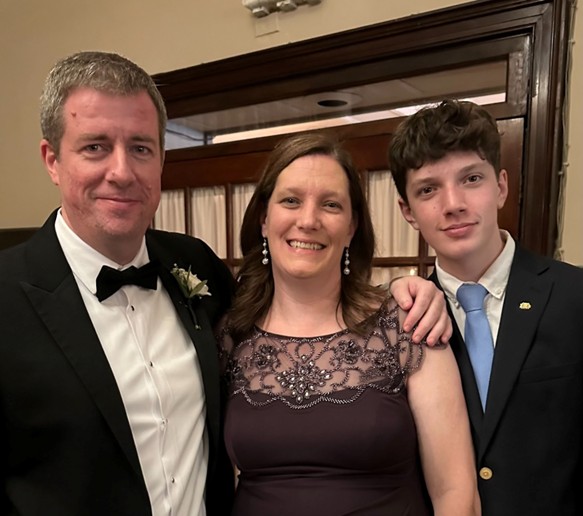 Dr. Ciara Shaver is a physician scientist and Assistant Professor in the Division of Allergy, Pulmonary, and Critical Care Medicine within the Department of Medicine. She is also the Associate Director for the Vanderbilt Center for Transplant Science where she facilitates translational science across transplant disciplines. She manages a basic and translational research lab studying why different donor lungs have different clinical outcomes after transplantation.
Dr. Shaver credits her primary interest in science to her father, a medical doctor and NIH-funded scientist himself. In between her years at Rice University, she had the opportunity to work in Dr. Jeff Gordon’s lab at WashU in St. Louis. She was inspired by working with a clinically trained scientist who showed her the wide variety of science out there for learning. He suggested that she pursue an MD/PhD program and clued her into how many different things are discoverable in science.
For her MSTP training, Dr. Shaver went to Northwestern University Feinberg School of Medicine. Her PhD is in Immunology and Microbial Pathogenesis and her advisor was Dr. Alan Hauser, MD, PhD (now their MSTP Director). She studied the relative contributions of Pseudomonas toxins to the pathogenesis of pneumonia using primarily animal models. She loved that her doctoral research experience included in vivo studies, was clinically relevant, and allowed her to dissect a complex system. She also really thrived in a lab where she had direct interactions from her mentor. After her training she knew she wanted to pursue internal medicine, but was not sure what she wanted to subspecialize in.
Dr. Shaver came to Vanderbilt for her internal medicine residency, and chose to not apply into fast-track PSTPs. She really enjoyed hands-on patient care and wanted the full residency experience to give her more time to explore subspecialties. She loved her third year as a resident, when you finally feel like you have gained some expertise. She also did a year as Chief Resident at the Veterans Affairs (VA) hospital. Dr. Shaver loved her chief year because it was full of clinical care, teaching residents and students, and thinking about how the hospital system works and why we take care of people the way we do. She says the administrative insights as chief resident were particularly valuable, as she would attend meetings between different departments and disciplines.
As a resident, Dr. Shaver also had her first translational research experience using human clinical samples. She first met her mentors, Dr. Julie Bastarache and Dr. Lorraine Ware, when rotating in the ICU. Her first project with Dr. Ware was studying atrial fibrillation and its contributions to mortality in the ICU. They showed that atrial fibrillation was an independent predictor of death in critically ill patients. This was the first time Dr. Shaver had done any clinical data extraction from hospital charts and was her first foray into multivariable statistics. Little did she know that this would catalyze a long-term partnership – now, Dr. Shaver co-runs her lab with Drs. Bastarache and Ware in the Laboratory for Science and Translational in Critical Illness.
Dr. Shaver decided to pursue a pulmonary critical care fellowship. She applied for the fellowship while her husband Dr. Aaron Shaver, a pathologist, was finishing his residency. They were able to both match to fellowships at Vanderbilt at the same time. Dr. Shaver says, “there are always challenges in any two-job household, and it’s particularly challenging for two clinicians. We have been very fortunate to have two supportive divisions who were willing to commit to us then and many times since. This has been critical for success as a dual physician-scientist household.”
Early in her fellowship, Dr. Shaver decided to subspecialize in lung transplant medicine. Drs. Ware and Basterache were crucial in developing a good training program for her to become a basic and translational scientist while building her clinical sub-specialization. At the time, Vanderbilt didn’t have many people doing science in the transplant space, so Dr. Shaver worked to build a research foundation in studying lung injury in basic and translational models. She developed an ex vivo lung perfusion model system to do mechanistic research in an intact human lung. She also studied many different aspects of lung injury in animal models.
This setup helped her leverage the best combination of research mentorship and clinical exposures. On the clinical side, when Dr. Shaver started in the transplant team, it was a small program (20 transplants a year) and she worked very closely with just a few attendings to learn the field. Now, the lung transplant program has grown to transplanting more than 120 patients a year. She says that being a part of the institutional growth and investment into transplant turned out to be an awesome career opportunity. She was able to have a role in building a lung transplant research program while growing the clinical enterprise. Dr. Shaver says, “it was the perfect place to be an MD/PhD because I had 1 foot in the clinic and 2 feet in research.”
As Dr. Shaver joined faculty, she initially served in an instructor role while supported with a Vanderbilt Faculty Research Scholars Award and a Parker B. Francis Fellowship in Pulmonary Research. When her K08 was funded, she was promoted to Assistant Professor with additional start-up support from the Department. Over the last several years, Dr. Shaver has continued to expand her research and develop numerous collaborations, both at Vanderbilt and beyond. She has really enjoyed participating in the development and launch of the Vanderbilt Center for Transplant Science. She has also served in a number of different roles for her professional societies, including chairing grants committees and co-chairing international conferences.
Dr. Shaver’s lab is now funded by multiple NIH grants in addition to industry studies. Her group focuses on mechanisms of lung injury in organ donors, investigating what the mechanisms underlying the injury are and working to develop novel strategies to mitigate this injury. She is also working with her surgical colleagues including Dr. Matthew Bacchetta to use porcine cross-circulation to repair damaged human organs to be suitable for transplant. Dr. Shaver directs the Lung Transplant Biorepository and Explant Biorepository, which facilitate a broad range of research in transplant and in chronic lung disease. Her research program spans everything from basic science, animal models, ex vivo lung models, and translational work with patients. She really enjoys being able to have a team made of attendings, post-docs, residents, fellows, students, research coordinators, and nurses. She says it’s the best kind of multidisciplinary research, letting everyone contribute to the discovery.
When asked to give advice to MSTP trainees, specifically early phase trainees, Dr. Shaver suggests, “don’t be afraid to try something new and explore an area you don’t know anything about. If you don’t try it, it’s harder to judge if those things would be part of what you want to do with your life.” As an MSTP student, she would have never imagined how much translational and clinical science she is doing – at that time, she was a mouse biologist! For later phase MSTP trainees, she advises, “really embrace your clinical time and learn all you can. After you finish training, clinical work is always balanced against something else. There are very few times when you are fully protected to do either clinic or research, so really embrace the time you get to spend immersing yourself in the medicine.”
Her general advice to all MSTP trainees is, “live your life and do it the way you want. Training is long, but your career afterwards is even longer. You are in control of your happiness and your success, and you get to do something that you love. You get to pick your balance between science and medicine – this can change over time too. Embrace the complexity and craft it to meet your individual needs.” Dr. Shaver also says to remember that there is more to life than work. Dr. Shaver has stayed focused on being home to eat dinner together as a family every night with her husband and son.
Dr. Shaver is really excited to have joined the Vanderbilt MSTP as a college advisor and looks forward to interacting with the students in the coming years. Please do not hesitate to reach out to her if you have questions about medicine, science, collaborations, or how to thrive as a dual-trained physician scientist.