Extracellular Vesicles
-

Exploring a new frontier in cell communication: A Q&A with the Burnette lab on blebbisomes
Since its publication on February 21, 2025, the Burnette Lab’s article detailing the discovery of blebbisomes—a newly identified class of extracellular vesicles—has received over 44,000 Article Accesses, a remarkable benchmark for scientific reach and engagement. This visibility is due in part to Vanderbilt University’s new open access agreement with… Read MoreJune 13, 2025
-
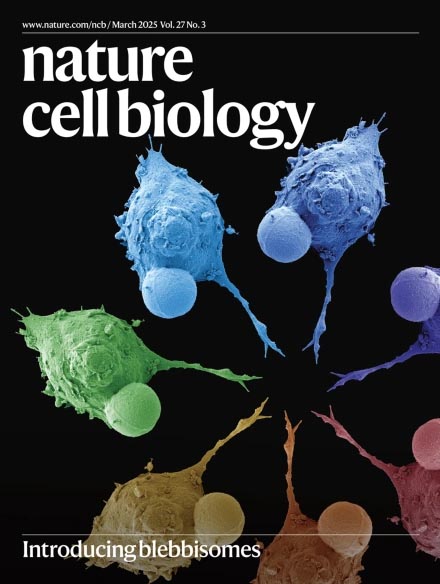
Exploring a New Frontier in Cell Communication: A Q&A with the Burnette Lab on Blebbisomes
Since its February 2025 publication in Nature Cell Biology, a groundbreaking study from the Burnette Lab has drawn more than 44,000 Article Accesses—amplified by Vanderbilt’s new open access agreement with Springer Nature. The study reveals the existence of blebbisomes, massive, motile extracellular vesicles that behave almost like mini cells. Packed with organelles and capable of delivering immune-modulating proteins, blebbisomes may one day serve as therapeutic couriers or targets in cancer treatment. Read MoreApril 7, 2025
-

Alissa Weaver honored for excellence in research, service during 2024 Fall Faculty Assembly
Alissa Weaver, professor of cell and developmental biology, was honored for her work on a paper published in Developmental Cell titled “VAP-A and its binding partner CERT drive biogenesis of RNA-containing extracellular vesicles at ER membrane contact sites.” Read MoreAugust 26, 2024
-
Vanderbilt scientists develop new tool that could lead to noninvasive “liquid biopsies”
Researchers from the School of Medicine Basic Sciences recently developed an analytical tool called EV Fingerprinting that could lead to the use of “liquid biopsies” as a substitute for traditional biopsies for certain patients or diseases. Read MoreJuly 15, 2024
-

Vanderbilt basic scientists receive National Science Foundation grant to explore RNA behavior
Manuel Ascano and Alissa Weaver are one of nine research teams to receive funding to understand the potential biotechnological uses of RNA more fully. The research is expected to provide opportunities to partner with industry to translate knowledge gained in the laboratory into marketable new therapeutics. Read MoreMarch 18, 2024