Uncategorized
-

Lineage tracing in the gut
Scientists are finding that they can understand organ function (and dysfunction in the case of disease) better if they know where the cells that make up these organs came from. New single-cell technologies allow all cell states within a differentiating tissue to be identified. However, the relationships between cell states that… Read MoreNovember 30, 2017
-

Blackwell, Macara, Southward-Smith Elected AAAS Fellows
Timothy Blackwell, Ian Macara, and Michelle Southard-Smith have been elected fellows of the American Association for the Advancement of Science this year. They are among 396 fellows from around the country selected by their peers “because of their efforts toward advancing science applications that are deemed scientifically or socially distinguished.” They join other Cell and… Read MoreNovember 20, 2017
-

Macara elected AAAS fellow
Fifteen Vanderbilt University faculty members conducting a range of biomedical and clinical research have been elected fellows of the American Association for the Advancement of Science this year. They are among 396 fellows from around the country selected by their peers “because of their efforts toward advancing science applications that are… Read MoreNovember 20, 2017
-

A lipid’s role in cell division
Proper cell division is a basic process critical to cell survival. A ring composed of actin filaments and myosin motor proteins pinches the cell apart, producing two daughter cells with equal amounts of cellular components. Reporting in the Journal of Cell Biology, Kathleen Gould, Ph.D., and colleagues characterized how this powerful contractile ring… Read MoreNovember 17, 2017
-
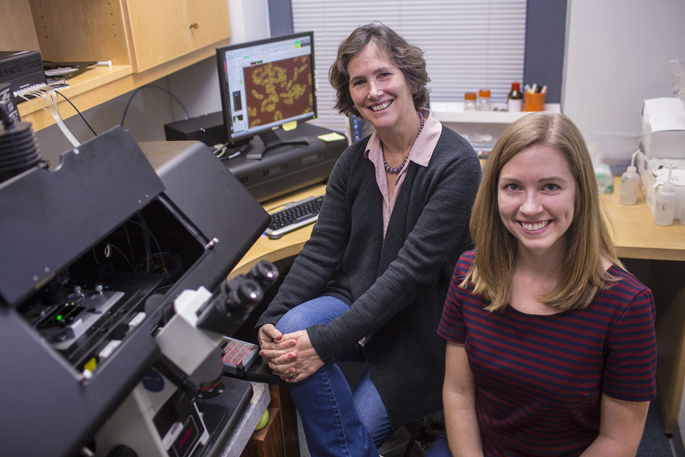
Gould and Snider are studying how the contractile ring forms and functions in cell division
For years, Kathleen Gould, Ph.D., and her colleagues have drawn models of the contractile ring — the molecular apparatus that physically divides cells — and its parts. They used genetic studies to probe how the protein parts fit together, but their models involved some educated guesses. “We drew things certain ways, but… Read MoreNovember 14, 2017
-

Sweatt, Tansey discuss influence of epigenetics on research
Basic research underway at Vanderbilt University Medical Center is raising hopes that one day it will be possible to reverse memory loss in people with Alzheimer’s disease and stop a major driver of cancer in its tracks. During a Vanderbilt Cutting-Edge Discovery Lecture last week, David Sweatt, Ph.D., chair of the… Read MoreNovember 3, 2017
-

Gut response to fluid flow
Flow of fluids through the gut, such as milk from an infant’s diet, generates a shear stress on cells lining the intestine. Ken Lau, Ph.D., and colleagues have demonstrated that microvilli – finger-like membrane protrusions – are capable of sensing shear forces and subsequently drive an intracellular response called autophagy. Read MoreOctober 27, 2017
-

Marija Zanic Participates in Flexner Discovery Lecture
A trio of Vanderbilt University scientists, including CDB's Marija Zanic, recently described their cutting-edge investigations of cellular dynamics and cancer treatment during a Flexner Discovery Lecture. Read MoreOctober 24, 2017
-

Brunette & Taneja earn top honors in Nikon small world photomicrography competition
Dylan Burnette won a top 20 (19th place) award in the Nikon small world photomicrography competition. Nilay Taneja won an image of distinction (top100) in the same competition. The competition invites images from scientists worldwide. Read MoreOctober 10, 2017
-

Cell signals that trigger wound healing are surprisingly complex
Despite a tremendous amount of scientific study, many outstanding mysteries still surround the way in which cells in living tissue respond to and repair physical damage. One prominent mystery is exactly how wound-healing is triggered.Using an ultrafast, ultraprecise laser, a team of physicists and biologists at Vanderbilt University has taken an… Read MoreOctober 4, 2017