Medical Physics

Professional Doctorate in Medical Physics (DMP)

If you’re looking for excellent training for a clinical career in diagnostic imaging physics, Vanderbilt is the place for you. Our Doctorate in Medical Physics (DMP) was the first accredited program in the United States, and we’ve stayed on the cutting edge of medical physics ever since.

An aerial view of Vanderbilt's campus in autumn.

[Getting] four solid years with individualized attention makes it seem less like school and more like career training.

Program Features

Community, networking and faculty mentorship

Network with a lifelong community of colleagues. The connections with faculty, technologists and fellow students last far beyond graduation. 

Y1-2

Rigorous, interactive coursework

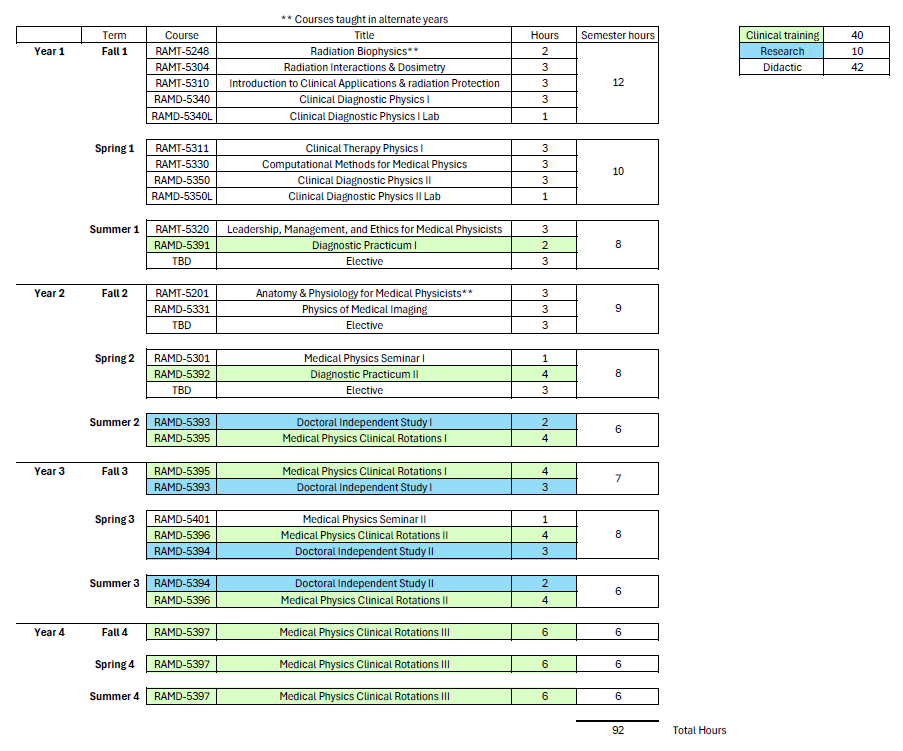
Build clinical foundations through physics, communication, collaboration, reflection, and a key oral exam in the spring of your second year. 

See sample academic plan.

Y1-2

200+ in-clinic hours

Gain hands-on clinical experience, mastering imaging tech, performing key tasks, and training alongside experts at VUMC and beyond. 

Y3-4

Monthly clinical rotations

Rotate to new clinical settings each month, building skills in radiography, pediatric imaging, ultrasound, MRI and nuclear medicine. 

Y4

Putting it all together

Partner with the radiologists in your clinical rotations to see how images are used to diagnose disease and inform patient care. 

6 credit hours of research

Complete 6 hours of research, publish and present your work, attend conferences, and gain skills for leadership in imaging and medical physics. 

DMP Beyond Coursework

  • Clinical Rotations: Building towards clinical competency

    After completing your two years of coursework, you’re ready to dive into two years of diagnostic imaging residency at Vanderbilt’s medical center. DMP students will also be provided a stipend during their 3rd and 4th year in the program. 

    Your third year marks the transition from didactic learning to supervised clinical responsibility. The skills you practiced in your clinical practicum during Years 1 and 2 will come into play on an everyday basis as you: 

    Rotate to new clinical settings each month 

    These rotations introduce you to the wide range of diagnostic imaging work. You’ll typically spend a few hours each day on rotation, with outside time set aside for completing clinic-related tasks and meeting with faculty advisers. 

    Your rotations will include months in: 

    • Radiography 
    • Pediatric imaging 
    • Ultrasound 
    • MRI 
    • Nuclear medicine 

    Learn from the guidance of expert clinicians at VUMC 

    • Year 3: Collaborate closely with the technologists in your clinical rotations, including x-ray technologists, nuclear medicine technologists, and sonographers. 
    • Year 4: Partner with the radiologists in your clinical rotations to see how images are used to diagnose disease and inform patient care. 

    Explore specialty medical physics care at our satellite locations throughout Nashville and the Middle Tennessee area. As you rotate through these satellite locations, you’ll get a taste for different clinical dynamics and team strategies. 

    Continue theoretical exploration by taking an optional elective class each year.  Join departmental meetings to learn how medical physics faculty manage a balance of clinical, research, and teaching work. You’ll work closely with both technologists and radiologists in your future clinical practice, so Years 3 and 4 are the perfect time to build your strengths as an interprofessional team member and clinician. 

  • Research: Explore the Cutting Edge of Medical Physics

    In your future practice, other professionals in your clinic space will look to you as an expert in imaging technology and techniques— and that’s why research experience during your DMP is so crucial. 

    In your path through the DMP, you’ll complete 6 credit hours of research, leading to a research manuscript and public presentation to faculty and other students. 

    Your research work will also provide opportunities to travel to regional and national conferences to present your work as well as build networks across institutions. 

    During your research months, you will: 

    • Develop a close working relationship with an expert faculty member as your research adviser 
    • Delve into the diverse areas covered by medical physics research 
    • Stay on the cutting edge of the field by further exploring the newest tools and techniques 
    • Network with researchers from other disciplines whose research touches on your work 
    • Craft an academic article that describes the work you’ve done, ready to submit for publication 
    • Create an oral presentation summarizing your research 

    Your research experience here will train you in innovative thinking and academic scholarship, equipping you for leadership in the field. 

  • What's Next

    After completing a DMP in diagnostic imaging, you’ll be equipped to: 

    Complete the 3-part ABR board certification exam: 

    • Part 1: a computer-based exam generally taken immediately after completing your two years of coursework 
    • Part 2: a computer-based exam focusing on specialty-specific knowledge in diagnostic imaging, generally taken immediately after the end of your fourth year 
    • Part 3: an oral exam covering the same knowledge base as Part 2, generally taken one year after passing Part 2. 

    Step into a full-time medical physicist position, equipped to move forward as both a competent leader and a curious life-long learner. 

An aerial view of Vanderbilt's campus in autumn.

Residency-Equivalent Training in One Place

Once accepted into DMP, you have two guaranteed years of residency-equivalent training at our state-of-the-art medical center under the guidance of the expert team of diagnostic imaging physicists at Vanderbilt. In our DMP, you’ll develop deep working relationships with world-renowned medical physicists, who’ll be your professors and advisors throughout your four years here. To them, you’re far more than an observer— you’re a future colleague.

Ready to Take the
Next Step?

Learn more about the application process, prerequisites, and cost of attendance. Questions? Email us at medicalphysics@vanderbilt.edu