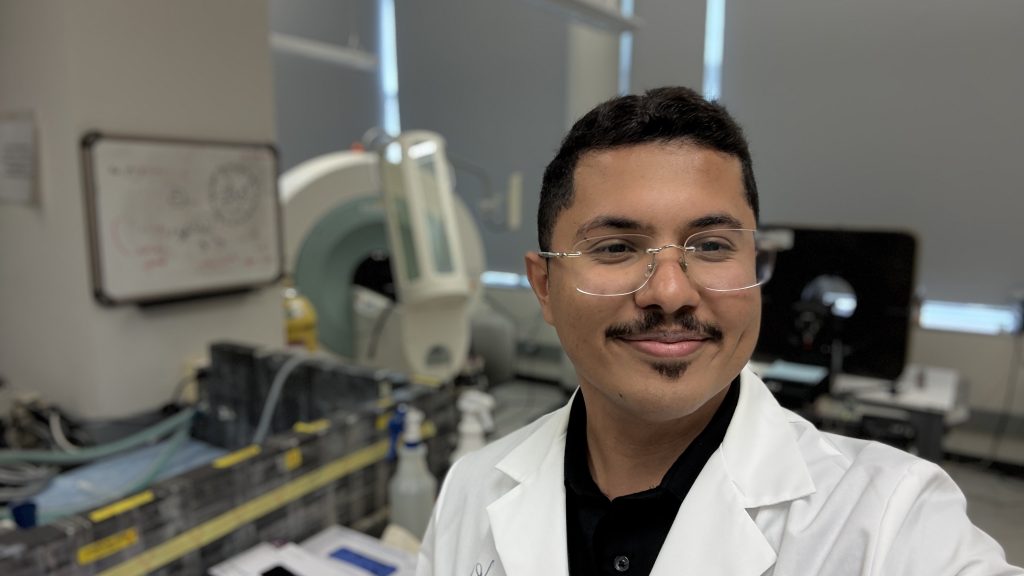
Growing up in Saudi Arabia, Khaled Alhulil, MIS ‘26, always had an interest in technology and healthcare. Carrying these passions with him to college, pursuing a degree in radiological sciences seemed to be the perfect way to bridge his long-time interests. After receiving his bachelor’s degree from King Saud bin Abdulaziz University for Health Sciences, however, Alhulil was faced with the age-old question for new graduates: what’s next?
Pondering the idea, he spent a year as an intern with King Abdulaziz Medical City and Johns Hopkins Aramco Healthcare and a teaching assistant at his alma mater. His rotations through imaging departments and work in education would eventually lead Alhulil to find his true passion.
“It’s only after acquiring experience that I realized the reality of the fact that my actual interest lies in the academic and research side of radiological sciences,” he said. “I want to take part in teaching, learning, and contributing to the advancement of the discipline.”
Driven by a new calling, “what’s next,” became clear; Alhulil began searching for an academic program that would allow him to dig deeper into his research and clinical imaging interests. It was during his search that he stumbled upon a program that, much like his undergraduate pursuits, brought together all of his newfound passions: Vanderbilt University School of Medicine’s Master of Imaging Science program. While many may be intimidated by the consideration of moving to a new country over 7,000 miles away, Alhulil knew almost immediately that the risk would be worth the reward.
“After speaking with Professor Todd Peterson, the program director, I was convinced,” he said. “His vision and what he shared with me about the collaborative environment of the program made my choice as clear as day. Though I had gotten offers from other top universities, I knew Vanderbilt was where I should be a place that combined academic excellence, innovation, and new exposures.”
Now almost a full semester into the program, Alhulil reflects on his experience as an MIS student and his post-graduate aspirations:
What drew you to pursue a master’s in Imaging Science?
Pursuing graduate studies was both a professional requirement and a personal ambition. I wanted to grow academically, contribute to my department and country, and stay at the forefront of innovation in imaging. The Imaging Science program perfectly aligned with my background and interests, combining technology and healthcare in exciting ways. Vanderbilt’s strong research focus, world-class faculty, and supportive environment made it the ideal place to take this next step, a journey that, for me, represents a challenge, a duty, and a dream.
What made you decide to attend Vanderbilt?
I remember distinctly the night I received word of my acceptance. It was later than midnight, and I was overjoyed. I received other offers, but I held off for Vanderbilt’s because I knew that it was what I was seeking. Every facet of Vanderbilt the academic environment, research availability, and social community made it the clear choice. In retrospect now, I can definitely say it was the right choice.
How has the transition to the U.S./Nashville been coming from Saudi Arabia?
Arriving in Nashville was a mix of excitement, curiosity, and a bit of fear. The first couple of weeks were challenging as I adapted to a new lifestyle and culture, but looking back now, I can only smile at how much I’ve grown. Living independently has taught me responsibility, balance, and self-awareness. This experience is helping me become more adaptable, open-minded, and learn to enjoy the journey one day at a time rather than rush toward the destination.
What has it been like having such a small cohort?
Having such a small group has been both a strength and a learning experience. On one hand, it’s allowed us to grow closer, understand each other’s perspectives, and create a more collaborative, supportive environment. On the other hand, in larger cohorts, you might easily find someone who immediately relates to your background while in a small one, the fun lies in getting to know people who are completely different from you. It’s both a challenge and a privilege.
Our relationships balance between academic collaboration and personal connection. We work together on coursework and share ideas, but we also genuinely enjoy each other’s company outside the classroom. The small size of the group also makes our professors more accessible, fostering closer mentorship and more interactive discussions.
It’s still early in the program, but I can already describe our cohort as unique and wonderfully different in the best way possible.
How has the experience been working with the VUIIS/VUSM faculty?
Working alongside the faculty members of VUIIS and VUSM has been an absolutely wonderful experience. From the very beginning, I was amazed at how wise, understanding, and friendly they were. The atmosphere they create is welcoming and encouraging. Their goal is not just to teach, but to make learning a pleasant and worthwhile experience.
Although it’s still early in the program, it’s clear that every faculty member is passionate, ambitious, and deeply invested in their students’ growth. They’re collaborative, attentive, and always willing to help us think critically and see the bigger picture in what we’re learning.
I would describe the experience as a genuine, friendly, and inspiring environment where everyone shares the same goal: to learn, grow, and aim high together.
What has been your favorite aspect of the program thus far?
One of my favorite courses so far has been Medical Imaging Physics and Engineering. It brings together everything I love: medical imaging, physics, and the engineering side of technology. The way Professor Seth teaches the class makes it even more enjoyable; his approach connects concepts seamlessly and keeps us engaged from start to finish.
Outside the classroom, I’ve also enjoyed attending the weekly VUIIS seminars, where researchers share their work and open up new perspectives on the field. Recently, I attended the annual VUIIS Retreat, which was an inspiring experience that broadened my view of current research and collaboration opportunities.
What are your core research/general areas of interest in the field of imaging?
I have a particular interest in combining artificial intelligence with imaging modalities before, during, and after image acquisition. I believe that AI has the potential to augment all aspects of the imaging process: from optimizing scanning parameters and real-time improvement of image quality to assisting post-processing, interpretation, and data management. My intention isn’t to replace the human input in these stages, but to augment and facilitate it with technology so that things become simpler, less of a burden, and generally better for patients and health practitioners alike.
I’m drawn to the technical and analytical content of imaging. I enjoy exploring the physics and engineering of imaging systems, and am amazed by how these technologies could be applied to meet real clinical requirements. Ultimately, I want to make my mark in the field, one that is based on erudite and practical innovations that connect science, technology, and humanity in meaningful ways.
What do you hope to do after you complete your degree?
After completing my master’s, I plan to pursue a Ph.D. in Imaging Science so that I can continue to enhance my knowledge and skills, and contribute toward advancing the field both academically and in research and teaching. My aspiration is to become both an educator and researcher, shaping the future generation of imaging scientists whilst progressing academic and clinical practice through innovation.
Though my specific Ph.D. research track remains in its nascent stages, my vision overall is set to continue to learn, grow, and contribute in ways that benefit the medical imaging field. I aspire to build a career that reflects constant improvement to be greater than the person I was yesterday, while positively impacting the academic and health care communities that I’m a part of.
Applications for Vanderbilt’s Master of Imaging Science program are now open. Tuition support is available to Vanderbilt University and Vanderbilt University Medical Center employees. Learn more and apply by the priority deadline (February 15, 2026) through the MIS website.