Renowned Massachusetts Institute of Technology molecular biologist David Bartel delivered a School of Medicine Basic Sciences Apex Lecture on Jan. 15 on the regulation of mRNA translation and decay. Bartel, a professor of biology at MIT’s Whitehead Institute, has made important contributions to the understanding of gene expression regulation, particularly the role of small regulatory RNAs called microRNAs or miRNAs, small, single-stranded RNA molecules that regulate gene expression in cells.
A reception in the MRB III atrium, just outside the lecture room where Bartel presented his talk, preceded the lecture. Graduate students, postdocs, and faculty from across campus mingled and discussed science with each other and with Bartel over a catered buffet.

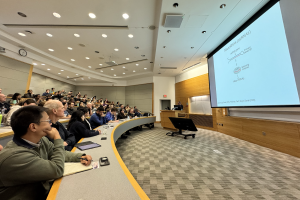
During his lecture, which was co-sponsored by the Department of Biochemistry, Bartel talked to a packed room about miRNAs and their role in gene expression. Gene expression can be viewed as a dimmer switch that regulates when, where, and how many RNA molecules and, consequently, proteins are produced. miRNAs can bind to mRNAs and either block their translation or cause their degradation, thereby regulating protein production and orchestrating physiological processes such as development, cell differentiation, and proliferation. There are about 90 highly conserved families of miRNAs in humans, each with hundreds of potential target mRNAs, and disruption of miRNA function can lead to severe developmental and physiological defects.
Bartel noted that miRNAs can regulate their targets through either “extensive complementarity,” leading to mRNA cleavage, or “partial complementarity,” leading to translational repression and mRNA decay. The stability of miRNAs themselves can vary greatly, with some being extremely long-lived, with a half-life of over a week, and others being very short-lived, with a half-life of a few hours.
The Bartel lab’s recent work has uncovered a process called “target-directed miRNA degradation” in which long non-coding RNAs can bind to and induce the degradation of specific miRNAs. Ongoing work is focused on identifying the specific lncRNA triggers that induce degradation of different sets of miRNAs in a tissue-specific manner.
Bartel also highlighted critical findings around the dynamic regulation of mRNA poly(A) tails—long chains of adenine nucleotides added to the 3’ end of an mRNA molecule during RNA processing to increase its stability— and how it impacts translation in different biological settings. He explained that there is normally a strong correlation between mRNA poly(A) tail length and translation efficiency, as longer tails lead to more efficient translation; however, this coupling breaks down in many cell types after embryonic development. The Bartel lab has used new methods to measure poly(A) tail lengths and translation for thousands of mRNAs simultaneously, allowing them to study the dynamics of poly(A) tail length changes over time. They found that mRNAs encoding stable, housekeeping proteins tend to maintain long poly(A) tails, while mRNAs encoding less stable proteins often have their tails rapidly shortened because of a limiting factor: the amount of poly(A) binding protein in the cell.
Finally, Bartel discussed recent discoveries surrounding the complex regulation of mRNA poly(A) tails and how it impacts gene expression. His lab uses new methods to precisely measure changes in the poly(A) tail lengths of thousands of different mRNAs over time, and has found that the poly(A) tails of mRNAs exhibit a wide range of behaviors—some are rapidly shortened, while others are longer for longer periods. The rates at which the tails are shortened and at which the mRNAs are then degraded are closely linked: rapidly shortened tails tend to lead to faster mRNA decay. This helps explain a previous finding that miRNAs don’t always change the overall poly(A) tail length distribution even though they are known to promote mRNA decay; the tails are just being shortened more rapidly.
In a different context where transcription is shut off, his lab found that specific sequence elements in the mRNA can direct either the lengthening or shortening of the poly(A) tail, and the tail length change then strongly impacts how efficiently the mRNA is translated into protein.
Bartel’s work shows that the poly(A) tail is a highly dynamic and regulated feature of mRNAs, with its length playing a crucial role in controlling both mRNA stability and protein production in different cellular contexts.
For more information about School of Medicine Basic Sciences Apex Lectures, please visit the SOMBS website.