Every August, the Vanderbilt University School of Medicine Basic Sciences opens its doors to a new cohort of graduate students embarking on the transformative journey toward a Ph.D. in the biomedical sciences. This year’s incoming class of 42 students in the Interdisciplinary Graduate Program and the Quantitative and Chemical Biology Program began their Vanderbilt experience with a week of orientation activities, community-building events, and a milestone tradition—the Simple Beginnings ceremony.
The IGP and QCB programs are one-year programs that offer trainees coursework and research components that set them up on the road to getting a Ph.D.in the biomedical sciences.
“Graduate students are such an important part of the fabric of our community,” Senior Associate Dean of Biomedical Research Education and Training Walter Chazin said. “It is wonderful to honor the new cohort of intelligent, motivated, accomplished, and creative young scientists. We treasure their perspectives, ideas, and enthusiasm.”
Learning the ropes
Orientation for both programs began on Aug. 11, with introductions from BRET faculty and staff, including Senior Assistant Dean of BRET Maria Hadjifrangiskou, Director of the IGP Madhvi Venkatesh, and Director of the QCB Ray Blind. Throughout the week, students participated in sessions tailored to help them navigate graduate school life. The week-long orientation emphasized the expectations of graduate study and the values of academic integrity, wellness, community support, and more. Students learned about Title IX, the use of animals in scientific research, and the importance of community support resources, setting the tone for a culture of care and accountability. A new addition this year was training on large language models, such as ChatGPT and Gemini, to help students learn to use these emerging technologies responsibly and effectively. All sessions aimed to prepare students for the challenges and opportunities of their first year of graduate school and beyond.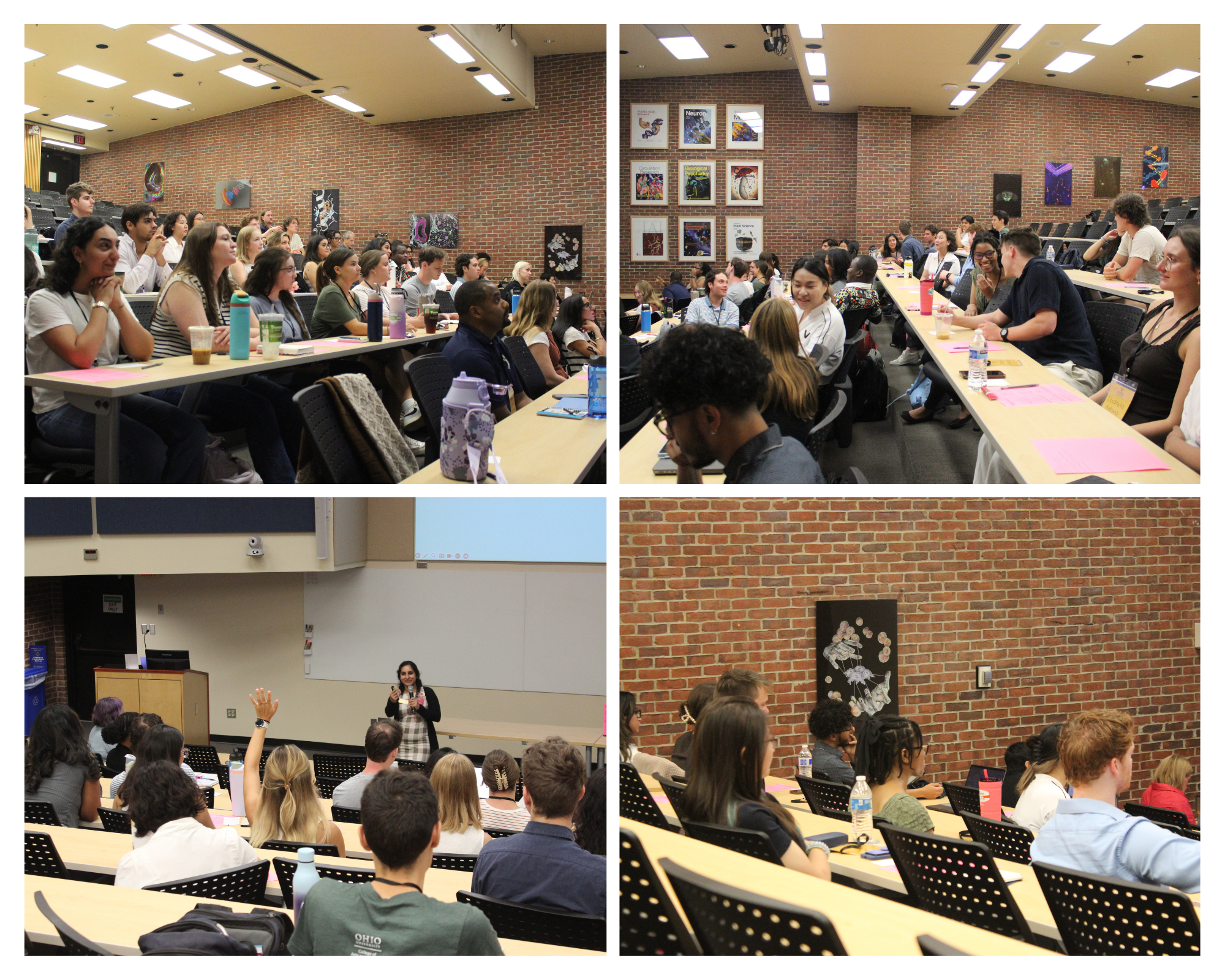 Beyond academics, the orientation week was about fostering belonging. Students engaged in peer learning group activities, an international student meet-and-greet, and networking with faculty and advanced trainees. These moments of connection highlighted Vanderbilt’s collaborative ethos—a hallmark of the biomedical graduate training experience.
Midway through the week, the incoming students gathered for one of the most anticipated events: the welcome celebration and dinner. Held at Carmichael College, this evening brought together students, faculty, and staff in a relaxed environment, offering students the chance to begin building friendships and professional connections that will sustain them through their doctoral journeys.
A beginning and a look ahead
The welcome festivities culminated on Aug. 29 at the Simple Beginnings ceremony, an event that has become a defining tradition for the SOMBS. Established 14 years ago, the ceremony commemorates the arrival of new Ph.D. students with a symbolic gift: the presentation of a personalized white lab coat.
Dean of the School of Medicine Basic Sciences John Kuriyan opened the ceremony with a message underscoring the importance of the Ph.D. journey as both a professional and personal transformation.
“Earning a Ph.D. is more than a marker of academic excellence: It’s a testament to your dedication to advancing human knowledge,” he said to the students. “It signifies mastery in your field and the ability to propel science with original contributions that create lasting impact.”
Kuriyan highlighted Vanderbilt’s world-class resources, from advanced cryo-electron microscopy and super-resolution imaging facilities to mass spectrometry and high-throughput screening, reminding students that they are entering an environment designed to enable ambitious research. But his remarks also focused on the personal dimension of the Ph.D. as he discussed resilience, curiosity, collaboration, and the relationships that will sustain students throughout their training.
He encouraged the students to view their time at Vanderbilt not just as training, but as an opportunity to make lasting contributions to science. “You may experience opportunities to make new discoveries that push the boundaries of human knowledge,” he said. “This process is not only exciting but also deeply transformative, as it allows you to evolve into a true expert in your chosen field.”
Following Kuriyan, Chazin addressed the audience, reflecting on the history and meaning of the Simple Beginnings tradition. “From so simple a beginning, we cannot yet imagine the breadth of discoveries that will result from the research these new students will conduct or the impacts they will have on our world,” Chazin said.
He also explained that while not every student will require a lab coat in daily research—some will focus on computational or theoretical work—the lab coat remains a powerful symbol of scientific training.
“It is a classic symbol of scientific training,” Chazin noted. “More importantly, today’s ceremony marks the starting point on the road to the Ph.D. You have been given a gift of time to learn, to discover new knowledge, and to become the highly capable person you want to be.”
During the ceremony, students were individually presented with their coats, symbolizing both their entry into the Vanderbilt scientific community and the beginning of their professional careers. Friends and family, many attending in person or tuning in via livestream, were reminded of their vital role in supporting the students during this challenging and rewarding journey.
“There is no doubt that graduate school will be challenging,” Chazin told families. “I urge you to remind your students of their accomplishments, their potential, and your own enthusiasm for the science they are pursuing.”
The ceremony concluded with a group photo and a reception in Langford Lobby, where students, faculty, and families gathered to celebrate.
For the newest class of biomedical graduate students, their orientation and the Simple Beginnings ceremony marked more than the start of coursework and lab rotations—it marked their entrance into a community dedicated to discovery, collaboration, and growth.
With a foundation of support from faculty, peers, staff, friends, and family, the SOMBS’s newest graduate students are poised to embrace the challenges and opportunities of their doctoral training. As Chazin reflected, the wonders that will result from these students’ “simple beginnings” remain beyond imagination, but the journey has now officially begun.