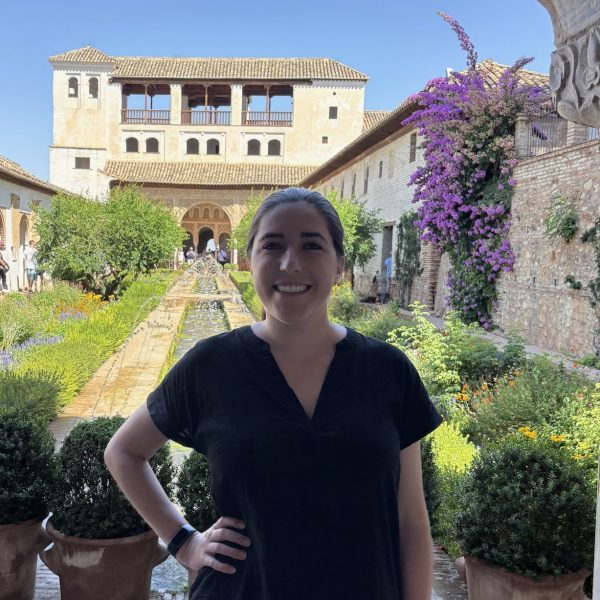
Meet Katherine Clowes Moster, a graduate student in the Department of Biochemistry who is studying a voltage-gated potassium channel called KCNQ1 in the lab of Chuck Sanders. We sat down with Katherine to talk about her experience as a trainee at the Vanderbilt University School of Medicine Basic Sciences, the mentorship and education that have shaped her journey, and what makes her unique in and outside of the lab.
What graduate program are you in?
Biochemistry.
Who is your advisor?
Chuck Sanders.
What drew you to Vanderbilt?
When I visited to interview for the Interdisciplinary Graduate Program, my immediate impression was that the students at Vanderbilt were very happy. They worked hard and did really interesting science, but I could tell Vanderbilt also encouraged an environment where the students had time to maintain their own personal lives and hobbies, which helped them get through the harder parts of graduate school without feeling discouraged. This was really important to me and ultimately was a big factor in me choosing to come to Vanderbilt!
What is your current area of research and what is exciting about it?
I study a voltage-gated potassium channel called KCNQ1. Pathogenic variants in KCNQ1 cause type 1 long QT syndrome, or LQT1, a cardiac disorder that increases risk of cardiac arrhythmia and cardiac arrest. My project investigates how disease-associated variants in KCNQ1 can lead to mistrafficking of the protein and whether that mistrafficking could be remedied to treat LQTS. I used high-throughput screening to identify small molecules that alter KCNQ1 expression levels and/or trafficking and characterized several of the hits from the screen.
I found two small molecules that are effective on disease-associated variants of KCNQ1 and that have other desirable properties. This work is exciting because it provides early evidence for a potential method to treat LQT1, a disease that impacts thousands of people across the world that currently has no treatment designed to target the underlying defects in KCNQ1.
What do you like best about being a trainee? What do you enjoy about being in your lab?
My lab is full of great scientists who are also really nice people, so we have a very supportive and collaborative environment. Being able to work with and learn from them has been one of the best parts of being a trainee here at Vanderbilt!
What is the hardest part about being a trainee and how is it helping you be a better scientist?
I think one of the best but also most challenging parts of being a trainee is how many new things you learn every day. I love having variety in my days, but it is also a great challenge to learn how to pick up a new protocol and get it to work, go through the trial-and-error period of using a new instrument, or work through preparing your results for a publication for the first time. These experiences have taught me how to problem solve, how to find and quickly synthesize information, and how to ask for help when I need it.
How has the community at Vanderbilt supported your growth as a scientist and person?
The community at Vanderbilt has been incredibly supportive throughout my training. In addition to my lab, I have been heavily involved with the biochemistry department and the Chemical-Biology Interface training program, where I have made many friends and have met other scientists who have inspired and supported me.
What Vanderbilt facilities and/or resources do you use (or frequent) the most and why?
I have worked closely with a number of shared resources during my time at Vanderbilt, including the Vanderbilt Institute of Chemical Biology’s High-Throughput Screening Facility and Molecular Design and Synthesis Center, and VUMC’s Flow Cytometry Shared Resource. Each resource has people who have gone out of their way to help support my training and my experience at Vanderbilt. The Office of Biomedical Research Education and Training has also been a great source of academic support and career preparation that I know will benefit me in my future job search.
What mentoring or training have you received that has been beneficial to your time here?
In addition to my PI, I have also been mentored by a senior postdoc in my lab, Katherine Stefanski. Katherine has been an incredible mentor for me, helping me design well-controlled experiments, master new techniques, and generally navigate the many ups and downs of getting a Ph.D. I am very thankful for the time and support that she has given me over the last several years!
What’s something fun, quirky, or unexpected about you that people may not know?
Though I don’t think I have a noticeable accent, I am from West Virginia and am incredibly proud of my Appalachian roots. I spent a lot of my summers in high school attending summer camps across the state, and it gave me a great appreciation for the natural beauty of West Virginia and the many wonderful people who live there. We have a national park now, the New River Gorge National Park, and I am always recommending people come to West Virginia and check it out!
What do you do for fun when you are not in the lab?
I love to cook, and I love to eat! My husband and I are always trying out new recipes and searching for great restaurants in Nashville. One of our favorite restaurants is Butcher & Bee in East Nashville. They make a whipped feta dish that we have been trying to replicate at home, but so far, we have not been able to top their version!