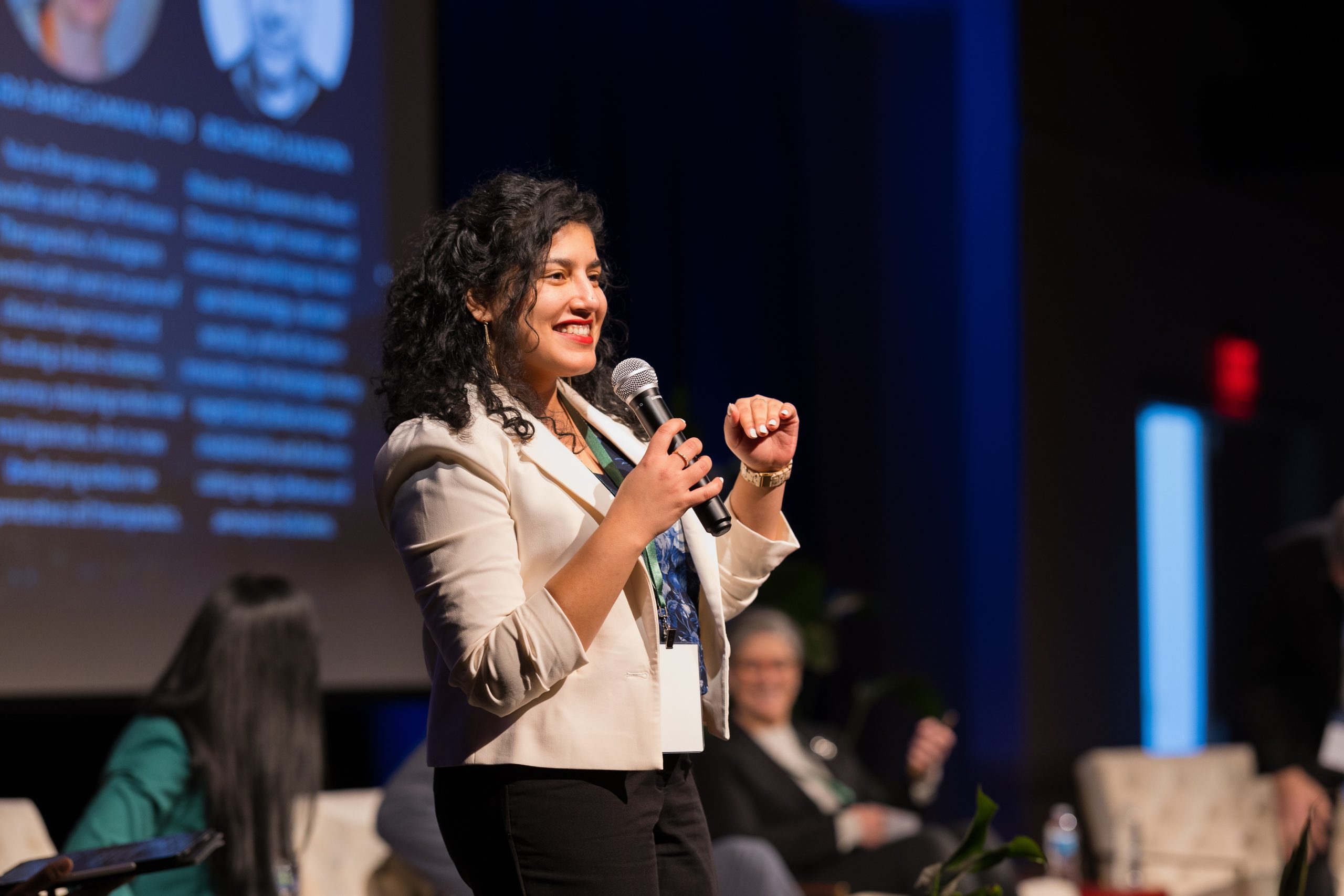

Kavya Sharman, BS’16, PhD’22, is a Dore through and through. She earned her undergraduate degree in neuroscience at Vanderbilt University, then worked at the Department of Biomedical Informatics and a startup before entering Vanderbilt’s Interdisciplinary Graduate Program. She completed her Ph.D. in Chemical and Physical Biology in 2022, working in Emeritus Professor of Biochemistry Richard Caprioli’s lab. She continues to serve as a guest lecturer and mentor at The Wond’ry.
“Vanderbilt has been a critical part of my life for over a decade now,” Sharman said.
While pursuing her undergraduate and graduate degrees at Vanderbilt, Sharman took an unconventional approach to her education. She enrolled in management and business courses alongside her scientific training, developing a unique blend of research expertise and commercial perspective.
While in graduate school, she co-founded S Phase Bio Fund with fellow students Cody Marshall and Pragun Tuladhar to invest in small- to mid-cap publicly traded biotech companies. The fund served as a training ground that taught graduate students how to apply their research skills to the biotech industry through practical lessons in discounted cash flow analysis, Securities and Exchange Commission filings, and investment fundamentals.
What began as a student initiative to understand investing became the foundation for Sharman’s next venture. She channeled her dual expertise in science and business into launching Phase Capital, a Nashville-based venture capital firm focused on tech bio that invests in early-stage companies at the intersection of biology, technology, and data. Today, she supports founders working to transform scientific discoveries into scalable applications across the U.S.
We had some questions for Sharman, and here are her alum answers.
What skills or knowledge gained during your time at Vanderbilt have been most valuable in your current role or industry?
The most valuable skills I learned were technical depth and interdisciplinary fluency, which I rely on every day. During my graduate research, I was the only computational student in my lab. I was fortunate to be co-mentored by collaborators in The Netherlands, specifically Raf van de Plas (who is also an adjunct assistant professor of biochemistry at Vanderbilt) and his lab at the Delft University of Technology, part of the Delft Center for Systems and Control. The Delft group was entirely computational and operated in a technical framework that was new to me, particularly as I was just beginning to learn how to code.
I was drinking from the proverbial firehose, bridging two technical worlds in learning biochemistry and mass spectrometry techniques while grappling with complex computational calculations. Every week, I met with mentors focused on biochemistry and others focused on data and I had to bridge the complexity of both worlds. I couldn’t just mentally translate the fields. I had to learn how to be precise and specific while communicating with different teams.
That fluency across disciplines sharpened my ability to translate complex science across disciplines at different depths. I’m incredibly grateful for that experience and now encourage students to work at the center of the Venn diagram, where meaningful growth and technical depth tend to converge.
At Phase Capital, that background informs a disciplined investment approach grounded in technical differentiation, data-driven defensibility, and realistic translational timelines. Rather than funding ideas in isolation, we focus on backing founders early and supporting the strategic decisions required to move scientific discoveries toward validation, scale, and long-term impact.
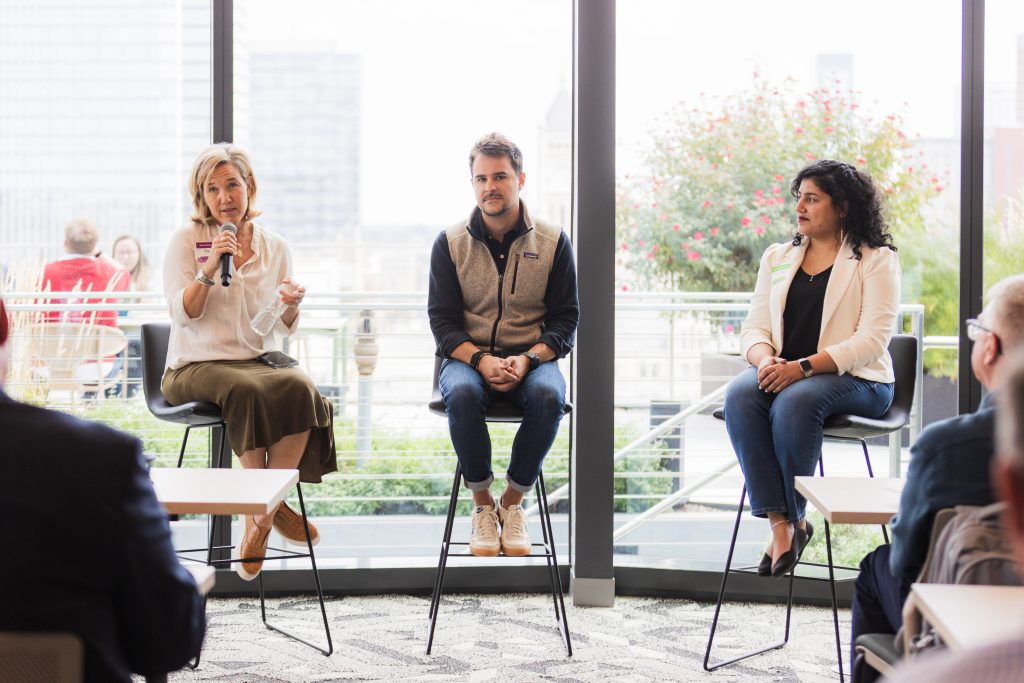
Were there any specific mentors or faculty members who played a crucial role in shaping your career aspirations? How did they influence you?
So many people at Vanderbilt played pivotal roles in shaping my path, and I’m deeply grateful for that ecosystem of mentorship. Early on, Associate Professor of the Practice of Business Studies Joe Rando’s managerial studies courses gave me a foundational business lens. I still turn to his advice at least weekly: “If you don’t know where you’re going, how will you know when you get there?” That principle continues to shape how I approach strategy, both personally and in my advisory roles.
I was also fortunate to be mentored by Beth Bowman and Michelle Grundy, first as faculty advisors when I co-founded the Scientific Immersion and Mentorship program with then-undergrad student Ariel Helms Thames, and later during my time in the Interdisciplinary Graduate Program. My research mentors, including Todd Giorgio and Dr. Michael Cooper when I was an undergraduate and Richard Caprioli and Jeff Spraggins during my graduate work, shaped how I think as a scientist, communicator, and leader. Richard, in particular, influenced me deeply as someone who bridged the worlds of academic science and entrepreneurship and modeled what it looks like to translate research into real-world impact.
One of my most formative experiences came through Todd’s lab, where I had a front-row seat to the entrepreneurial journeys of graduate students like Sinead Miller and Charleson Bell. I watched Sinead build a microfluidics company focused on sepsis, raise capital, launch, and ultimately move from Nashville to Memphis, Tennessee, and then Houston, Texas. I stayed in touch as her company grew. I also saw Charleson follow a similar founder path before returning to Vanderbilt as faculty. Seeing their journeys up close gave me a clearer understanding of how capital and infrastructure shape company growth. Those experiences influenced my decision to build Phase Capital as a national platform while remaining deeply connected to Vanderbilt and Nashville.
I was also influenced by Dr. Mark Frisse, whom I met after attending a talk simply out of curiosity. That single introduction led to my first role at Vanderbilt after undergrad and left me with a lasting appreciation for the power of curiosity, engagement, and genuine relationships.
There are many others who continue to influence me, including Ashley Brady, Carolyn Berry, and my thesis committee members, whose guidance I still return to as I build Phase Capital and grow as a leader. Vanderbilt gave me not only an education, but a lifelong network of people whose ideas and perspectives are woven into the decisions that define my work.
How has the interdisciplinary nature of your Vanderbilt biomedical education played a role in your ability to collaborate with professionals from different fields?
My work today centers on being the connective tissue between founders, often scientists, and the broader ecosystem of investors, advisors, operators, and partners. I was drawn to Vanderbilt’s IGP specifically for its interdisciplinary design; I came in wanting to learn how to code and left having trained across immunology, genetics, and chemistry before ultimately working at the intersection of data science and biochemistry. That experience fundamentally shaped how I think and collaborate with others.
Today, as I evaluate and support startups across the tech bio ecosystem, I can move fluidly between neuroscience, immunology, and genetics companies because of that foundation. Vanderbilt trained me to connect across disciplines, which now plays a crucial part in how I diligence companies, translate complex science for decision-makers, and build trust across technical and business stakeholders.

If you’re no longer conducting research as part of your job, how did your involvement in research projects at Vanderbilt contribute to your current success? If you are conducting research, what did you learn at Vanderbilt that has set you up for success in your current role or throughout your career?
Even though I no longer conduct research, my training at Vanderbilt and time building S Phase Bio Fund (which morphed into S Phase Bio Club) has guided every chapter of my career and fundamentally shaped how I how I think, ask questions, assess evidence, and make decisions under uncertainty. Having lived inside the research process shifted how I think about experimental design, scientific risk, and the realities of scaling discoveries into products.
This experience lets me see what others might miss: timeline feasibility, translational bottlenecks, and the variables that will drive success or failure. Now, at Phase Capital, we don’t fund ideas in isolation: We fund the people, infrastructure, and experiments required to bring technologies to market.
Looking back, what advice you would give to current biomedical students or postdocs based on your own experiences and the lessons you’ve learned along the way?
Universities, especially Vanderbilt, routinely bring in powerhouse speakers, and while it’s easy to stay in your own department, I highly recommend attending talks from guest lecturers. Take a pen and a notebook to capture thoughts, but let yourself absorb with no goal other than to integrate the information in your mind. You never know when it may resurface – when you’re staring at your data and suddenly a pattern you learned in astrophysics or a regression model from chemistry helps explain your science.
I remember sitting in on an astrophysics lecture purely out of curiosity and feeling like a kid learning about space again. That sense of curiosity stayed with me, and last year during our second annual Frontiers Summit, we included a panel on biotech and space. It felt like such a full-circle moment.
The key is to go in with no expectations other than gaining an appreciation for something new. Also, say hi to the speakers. They always appreciate it, and again, you never know where that may lead. (This is how I got my first job at Vanderbilt working with Dr. Mark Frisse!)
What’s something fun, quirky, or unexpected about you that people may not know?
I love to drive. For me, it’s almost meditative. On a recent trip to San Francisco, California, the highlight wasn’t sightseeing or Napa wineries (though both were definitely memorable), it was renting a fast convertible and driving up U.S. Route 1 with no GPS or plan, just taking in the coast and occasionally stopping to admire the view. There’s something about being behind the wheel on a road like that: you have no choice but to be present and enjoy the moment.