
It’s Valentine’s Day, and love is in the air! At the Vanderbilt University School of Medicine Basic Sciences, it’s even in the lab air.
Love doesn’t always occur where you expect—a coffee shop, a social gathering, a meet-cute in the park—sometimes it develops over shared research challenges or while troubleshooting an experiment at midnight. A Ph.D. in biomedical research is demanding enough without navigating a relationship, yet somehow these SOMBS and Vanderbilt alums not only completed their degrees but found lasting partnerships with other Ph.D. students along the way.
Whether they met at the bench or bonded over research setbacks, these alums prove that meaningful relationships can flourish alongside rigorous scientific training. We asked them to share how they did it.
Responses may have been lightly edited for length, grammar, and clarity.
Kristin Kwakwa, PhD’21, and Kalen Petersen, PhD’19
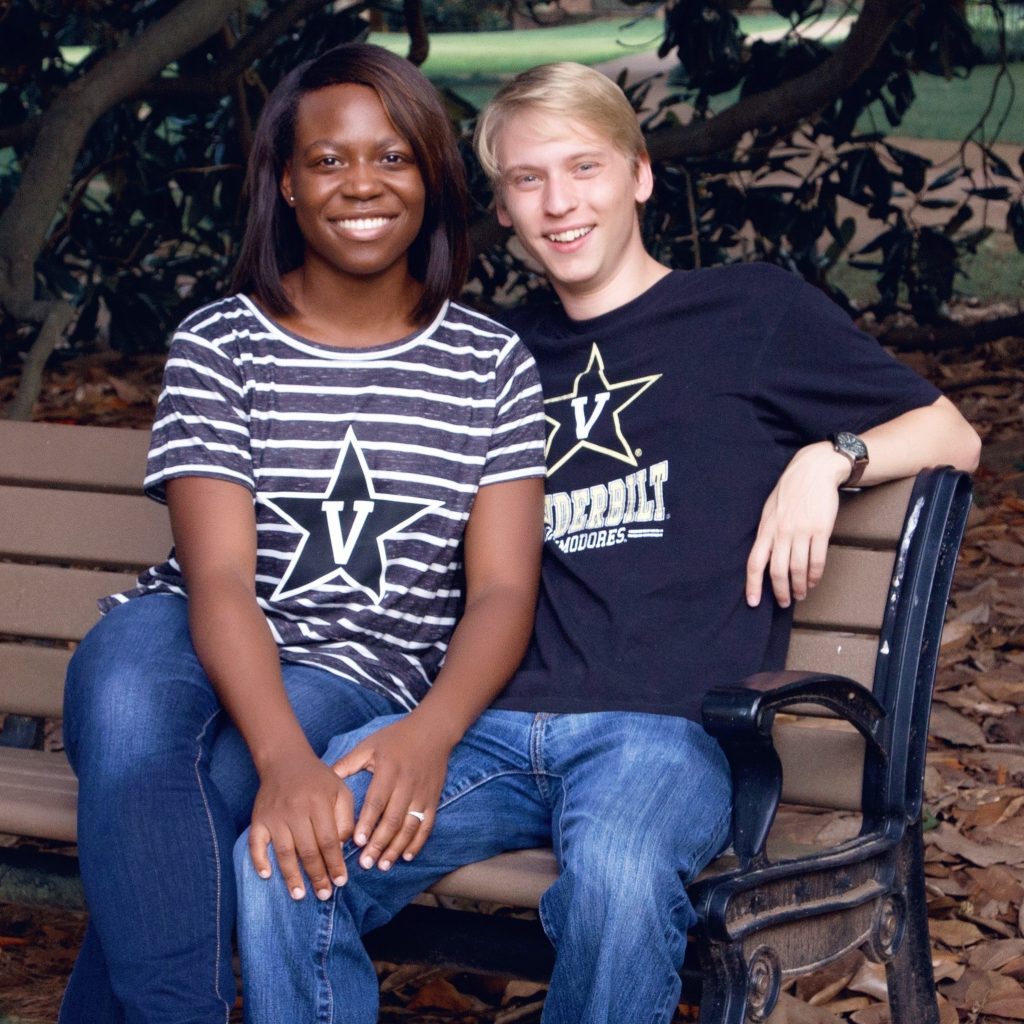
Kalen Petersen and Kristin Kwakwa live and work in St. Louis, Missouri. Kalen is an assistant professor of neurology and Kristin is a staff scientist in the Division of Molecular Oncology at the Washington University School of Medicine.
How did you meet?
We met in the fall of 2014 at a social event for incoming Interdisciplinary Graduate Program students.
Do you talk about your research at home?
Sometimes, like when we’re editing abstracts or grants, asking for advice, or venting about a failed experiment. But we usually talk about other things, like whatever our toddler did that day.
What is your favorite thing to do together?
We love playing board games and watching movies together. We also enjoy hiking, camping, and traveling to new places.
What advice would you give to couples in grad school?
Research is important, but don’t forget to have fun! Make time for each other and for family and friends!
Christal Sohl, PhD’10, and Hans Aerni, PhD’11
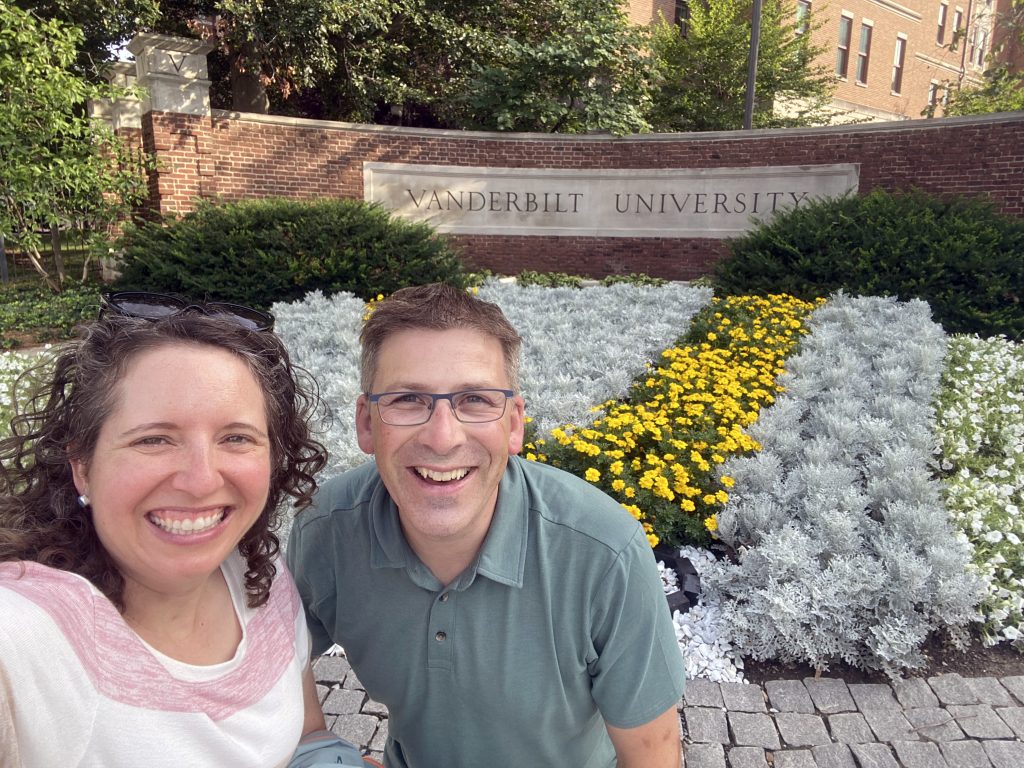
Christal Sohl and Hans Aerni’s love story started in a proteomics class during their graduate training. Sitting in class, Christal was impressed when a student behind her critically analyzed data. Realizing that he was also quite handsome, in a “not-so-suave nerd” move, Christal asked Hans for a tour of the rat sectioning instrument in his lab. At the end of the tour, Hans asked Christal out for coffee, and they haven’t looked back since.
Christal graduated from Fred Guengerich’s lab in 2010, and Hans graduated from Richard Caprioli’s lab in 2011.
Today, Christal is an associate professor of chemistry and biochemistry at San Diego State University and Hans is the executive director of CMC analytical development at Janux Therapeutics.
Do you talk about your research at home?
Though the environment where we perform research and manage/mentor people looks different, we are grateful to have a partner that understands the highs and lows of science, and a lot of troubleshooting happens at the dinner table. As we are both studying cancer, our work today has more overlap than in our graduate work. With a front-row view of Hans’ journey in biotech, Christal feels she can better prepare her students for careers in industry.
What is your favorite thing to do together?
Our hiking together began at Radnor Lake and Warner Parks, and it’s something we still love to do today, though we now do it year-round in San Diego! We also love to travel together, though of course time is always the limiting reagent!
What advice would you give to couples in grad school?
Embrace life inside and outside the lab. We have the honor of getting to tackle complex and interesting problems that can ultimately have a positive impact on humankind, and we think we are best equipped for these challenges when we also protect time for exploration, rest, and fun.
Abbie Neininger, PhD’22, and Mac Castro, PhD’22

Abbie Neininger graduated from the cell and developmental biology program and did her dissertation work in Dylan Burnette’s lab. Mac Castro’s Ph.D. is in biochemistry, having done his graduate work in the lab of Charles Sanders. Abbie is a senior data scientist at Oxford Nanoimaging and Mac is a scientist II at Altos Labs. They have lived in San Diego since they left Vanderbilt in 2022.
How did you meet?
We initially met during our interview weekend for the Interdisciplinary Graduate Program! We were acquaintances for a couple of years before our overlapping friend groups realized we would get along really well—they were right!
What is your favorite thing to do together?
When we moved to San Diego, we got into rock climbing and now go together several times a week! We also go to a lot of concerts and festivals, hike, go to the beach, and are now working on traveling to as many National Parks as possible.
Do you talk about your research at home?
All the time! We are acknowledged on each other’s first first-author papers and talk almost every day about what we’re working on. We give each other feedback, work through experiment ideas, and help each other. Abbie helps Mac in his new foray into cell biology research, and Mac helps Abbie with her chemistry questions.
Oakleigh Folkes, PhD’20, and Rafael Perez, PhD’20

Oakleigh Folkes and Rafael Perez are both alums from the Department of Pharmacology. Rafael is now an associate research scientist in the psychiatry department at the Yale University School of Medicine, where he studies opioid tolerance. Oakleigh is also an ARS, but she is working on the neuronal mechanisms driving social deficits in autism spectrum disorder in the genetics department.
Oakleigh and Rafael have a small son and a dog named CRISPR. They dream of one day also adopting a cat they can call Ca(t)s 9 (a reference to Cas9, a component of the CRISPR system), but the Cat Distribution System has yet to choose them!
How did you meet?
The first time we met was at the welcome reception for incoming Interdisciplinary Graduate Program students, before we had even started our classes and lab rotations. This was in the lobby of Light Hall. There must have been about 60 people there, but I (Rafael) remember boldly introducing myself and having a nice conversation with Oakleigh while she tried to eat some hors d’oeuvres in peace a little away from the main party.
Do you talk about your research at home?
Yes, we still talk a lot about research at home. I think the main reason is that we really love our work and are very fortunate to be able to share it more deeply, since we are both in the same scientific discipline. The bad part is that it makes it harder to leave work at work, which isn’t always healthy, but we do try to carve out time for other things.
Have you ever collaborated professionally, whether on a paper, a grant, teaching, or other?
Yes, we have collaborated on papers since we were graduate students, and Oakleigh is an author in my manuscripts. Beyond these easily tracked examples of our partnership, we are instrumental to each other’s funding, mentoring, and research success by providing ideas, perspectives, and, frankly, receptive ears.
What is your favorite thing to do together?
These days, a lot of our time is consumed (happily so) by our two-year-old son. Being able to experience his growth and playing with him is truly the best. Aside from that, whenever we get a bit of time, we love playing big immersive video games together and traveling, something we have been doing since we started dating in grad school.
What advice would you give to couples in grad school?
Understand your values and what you want to accomplish together. Science can be very challenging and even lonely but having a partner in crime can make the journey even more rewarding and can elevate your career trajectory beyond what you can imagine. Being an academic means you are likely to have a nomadic existence, at least until tenure is achieved, which I’ve been told happens somewhere in your mid-50s. Yet, with the right companion, it can be quite the adventure. As long as you remain true to yourselves, things will work out!
Ela Howard, PhD’24, and Joe Howard, PhD’23

Ela Howard graduated in 2024 with a Ph.D. in cell and developmental biology and is a scientist I at the Wyss Institute at Harvard University. Joe Howard, who graduated in 2023 with a Ph.D. in mechanical engineering, is a senior mechatronics engineer at Berkshire Grey.
Did you talk about your research at home when you were in grad school?
During grad school, we talked about our research every night at dinner. We were the first test audience for every presentation and the fallback lab partner for late-night experiments. As a result, Joe considers himself an honorary expert in organoid research and Ela is probably the only biologist who has operated a CNC milling machine. We continue the tradition of sharing our day’s triumphs and tribulations every night at dinner.
What is your favorite thing to do together?
We love exploring the outdoors, both by hiking mountains or biking though forests, coasts, and hills on multi-day tandem bike tours.
What advice would you give to couples in grad school?
Take advantage of working on the same campus! Have a picnic lunch on the library lawn. Drop into each other’s labs for surprise visits. Bring snacks and meals to support those long experiments. We cherish these memories because these things are much harder now that we work far apart.
What’s been the funniest moment of navigating science and life together?
Science has been very present in our relationship from day one, and it has been fun to realize that we are each other’s type of weird! For example, when Joe suggested we buy a telescope to view the eclipses in 2023 and 2024, Ela didn’t need any convincing at all!
Jessica Sweatt, MS’13, and Tyler McCann, PhD’16

Jessica Sweatt is in her 12th year of teaching middle school science and engineering and Tyler McCann works as a medical science liaison in oncology for Daiichi-Sankyo. We checked in with them, and they shared a snippet from their lives:
Seventeen years ago, we were both first-year Interdisciplinary Graduate Program students, meeting for the very first time at IGP orientation at the zoo, where our graduate school love story officially began.
During our time at Vanderbilt, we both joined labs in the Department of Cell and Developmental Biology, working just one floor apart throughout our graduate training. At home, science was a frequent topic of conversation. We brainstormed experimental ideas, commiserated over failed experiments, and supported each other through the highs and lows of graduate school. Tyler helped Jessica troubleshoot Western blots and Jessica returned the favor by helping Tyler polish scientific writing projects. True teamwork, both in and out of the lab.
Today, life looks a little different. We’re busy raising three kids and chasing family adventures around the state of Colorado. We still love discovering new breweries and catching live music—habits we picked up during our Nashville days. We’re grateful that our shared graduate school experience laid the foundation for both a strong partnership and a life built together beyond the bench.
Laura Teal, PhD’23, and Jess Roetman, PhD’23

Jess Roetman is a medical communications and scientific publications specialist at Telix Pharmaceuticals. Laura Teal is a lecturer and scientific writing specialist for the master of science program in physiology at the University of Michigan. Jess and Laura defended their dissertations one day apart in 2023, though Jess’ degree was in cancer biology and Laura’s in pharmacology.
How did you meet?
We met during Interdisciplinary Graduate Program orientation after admiring each other’s nerdy t-shirts.
Was there overlap between the research you each conducted in grad school?
Our research in grad school did not overlap beyond the fact we used rodent models. We are glad the IGP allowed us to meet as part of one cohort before we entered our respective programs. Our labs did trade some boxes of pipettes during the COVID-19 supply shortage, though!
Did you talk about your research at home when you were in grad school?
While neither of us do research these days, we are both scientific writers covering a board range of topics. We often get each other’s thoughts on sentence clarity/organization and like to learn about the science the other is working on.
Lori Rudolph-Owen, PhD’97, and J.J. Owen, PhD’98
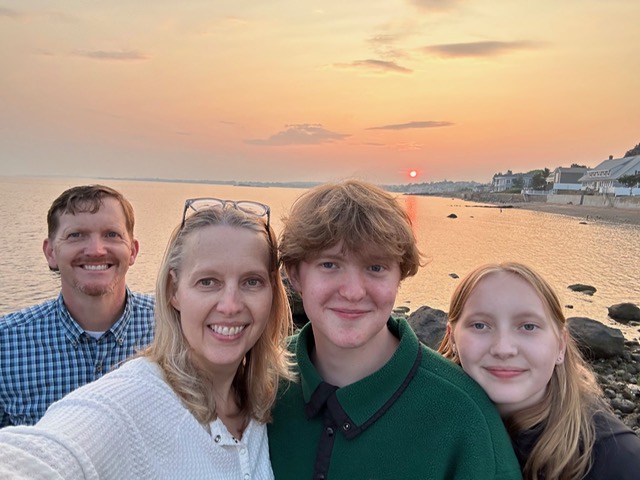
Lori Rudolph-Owen and her husband J.J. Owen have a deep School of Medicine Basic Sciences connection: Not only did they meet as part of the inaugural cohort of the Interdisciplinary Graduate Program in the fall of 1992, but today they are both part of the SOMBS Council of Visitors.
In addition to their roles in the COV, Lori is the chief development officer at 4:59 NewCo, a 5AM Ventures Company, and J.J. is a consultant at Owen Biopharma Consulting.
Did you talk about your research at home when you were in grad school?
Yes, we did talk about our research while we were in grad school, and we have always talked about our jobs at home while working in different companies.
Have you ever collaborated professionally, whether on a paper, a grant, teaching, or other?
Yes, J.J. did some consulting work for one of Lori’s companies.
What is your favorite thing to do together?
We love to spend time as a family with our kids. We travel quite a bit, but also love spending time boating, hanging by the pool or beach, and going to the theater and concerts together.
What’s been the biggest challenge (or funniest moment) of navigating science and life together?
Juggling having two kids (childcare, sicknesses, appointments, etc.) while both pursuing professional careers is challenging.
The best story was when our daughter Olivia was about two years old and our son Cole was four-and-a-half years old. It was the morning rush, and J.J. and I were both trying to get ourselves ready for work and the kids out the door to daycare.
That morning, I was heading to the airport to fly to New York City for a business day trip, so I was in a business suit. Olivia had just eaten a small breakfast, but when she came over and sat on my lap, I noticed that she felt a bit warm. She told me she wasn’t feeling very well right as I felt her stomach really start to gurgle. I leapt up and carried her over to the kitchen just in time for her to throw up in the kitchen sink! I looked at J.J. and said, “Well, I need to run to the airport, so I guess you’re on point to stay home today with a sick kid!” and literally handed her over to him as I walked out the door.
Megan Stone and Carl Stone
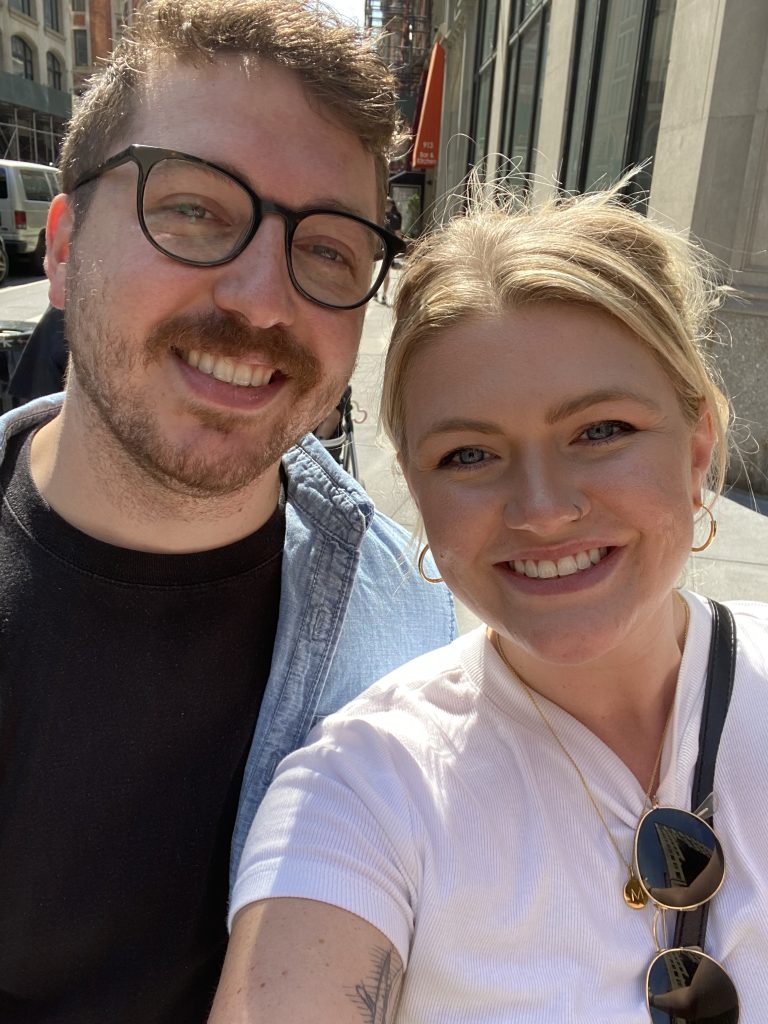
Although not yet alums, current graduate students Megan and Carl Stone are soon-to-be-doctors. Carl, a student in the biological sciences department, will defend his dissertation in just a few days’ time, on Feb. 17. Megan will defend her dissertation, conducted in the Department of Cell and Developmental Biology, later this spring.
2020 was a tough year for everybody, but being a first-year student (at any stage of your education) without having many of opportunities to meet classmates in person posed a particular kind of challenge. Megan and Carl, part of the 2020 cohort of the Interdisciplinary Graduate Program, met at a small, socially distanced gathering but became fast friends.
What’s been the biggest challenge (or funniest moment) of navigating science and life together?
A crazy part of being a couple in the same cohort in grad school is that a lot of times our personal and professional successes and struggles happen together at the same time. In our third year, we went through our qualifying exams, got engaged, and moved in together, at which point frozen pipes flooded our home and destroyed all our stuff. We each still managed to publish a paper, and we got married that fall. This chaotic era helped us develop a strong foundation and we know now that we can handle anything.
Do you talk about your research at home?
As a couple, we have learned to be very intentional with how we engage in work talk. There are times where we set a rule that we can’t talk about science on our commute home, and we always start a scientific conversation with “Do you have the space to talk science right now?” When the answer is “yes,” we love to bounce ideas off each other. When one of us is working through a tricky concept, we break out a white board at home and help each other organize our thoughts.
What advice would you give to couples in grad school?
Having mutual respect and admiration for each other and never competing are foundational aspects to our success as a couple. We work hard to build each other up and remind each other that we deserve to be here. Also, it’s very important to find individual and shared interests outside of sciences to maintain our identities as people and as a couple, not just a research power couple.
Danielle Golovin, PhD’20, and Randy Golovin, PhD’21

Randy Golovin, a neuroscience alum, is a postdoctoral scholar at the Herbert Wertheim UF Scripps Institute for Biomedical Innovation & Technology. Danielle Golovin, who earned her degree at Vanderbilt in biological sciences, is a senior biopharma analyst at BioCentury. The pair met while working in Kendal Broadie’s lab and now lives in Southern Florida with their two children.
Was there overlap between the research you each conducted in grad school?
Funny enough, even though we were in the same lab and sat back-to-back, we studied entirely different things. Randy analyzed how the brain responded to sensory input in a fruit fly model of fragile X syndrome, while Danielle was studying extracellular synaptic signaling using the fruit fly neuromuscular junction.
Did you talk about your research at home when you were in grad school?
Yes, we talked about our research very often in grad school. We still tell each other about our work now, but there’s a bit less time for that between wrangling two toddlers!
What is your favorite thing to do together?
We love to play board and card games, go bowling, cook, and make special moments for our kids.
What’s been the biggest challenge (or funniest moment) of navigating science and life together?
A funny story is that Danielle started in Dr. Broadie’s lab first, and then, a year later, Randy decided to do a rotation through the lab. Randy met with several of the lab members, including Danielle, to discuss which project he was eager to join, and he ended up picking someone else’s lab. So technically our relationship started with Danielle being rejected! But either way, Danielle is sure glad that Randy enjoyed the project enough that he joined the lab, and the rest is history … or is it science?
Lauren Walker, PhD’23, and Brad Pitcher, Fellow’23

Lauren Walker, who obtained her Ph.D. in microbe-host interactions in 2023, is a research specialist in the Division of Infectious Disease at The University of Pennsylvania. Brad Pitcher, who was a postdoctoral fellow at Vanderbilt’s Department of Earth and Environmental Sciences, is an assistant professor at the University of Delaware.
Although they were in different areas of research, serendipity brought them together at a Vanderbilt football tailgating event when the Interdisciplinary Graduate Program’s booth was next to that of the Graduate School.
“I like being married to a scientist because we have generally similar ways of thinking about the world, but our research is different enough from each other’s to keep things interesting,” Lauren said. “He is always teaching me new things!”
What is your favorite thing to do together?
Our favorite thing to do together is to be outdoors together! We love hiking, camping, rock climbing, and traveling. Our goal is to visit all the National Parks together. So far, we have made it to 17, I believe!
Our best moment together has been our wedding. We got to celebrate our wedding with friends and family from all over the world! Because we are both scientists, we have friends from when we were young, in undergrad, in grad school, and postdocs. Our wedding guests were a blend of friendships that we have gathered along the way. Academia is cool in that way: You get to meet so many amazing people that you wouldn’t have met if you didn’t have to move to a new town for school. I think we had something like 30-plus Ph.D.’s or M.D.’s at our wedding.
What’s been the biggest challenge (or funniest moment) of navigating science and life together?
Our biggest challenge was when Brad had to move to New York City for a lecturer position at Columbia University. I still had one year of grad school left and it was very hard on us. The last year of grad school is hard enough without your partner living in another city. Science isn’t like most other jobs: You really can’t pick where you want to live, you move where there is a job opening. My husband wants to stay in academia, and assistant professor positions are not easy to get.
I eventually moved to NYC with him. Then, one and a half years later, he got an assistant professor position at the University of Delaware. We had to do long distance again for a few months because I had a job in NYC that I was under contract with. We finally live together near Philadelphia, Pennsylvania, and hopefully we won’t have to live apart anymore.
What advice would you give to couples in grad school?
My advice is to date your best friend. Brad and I were friends for many years before we started dating. Over the years our friendship grew, and eventually we realized we wanted to be together. That is something else that couples in grad school should keep in mind: Finding jobs in the same city after school can be hard. With time and patience, though, you can make it work though.