Research News And Discoveries
-

Modulating stress circuits
Feb. 14, 2019, 12:00 PM by Leigh MacMillan (iStock) Stress contributes to psychiatric diseases including depression, eating disorders and addiction. Neurons that express the stress signal corticotropin releasing factor (CRF) in a brain region called the BNST are thought to promote negative responses to stress. Danny Winder, PhD,… Read MoreFebruary 15, 2019
-

Adhesion protein optimizes border
Feb. 14, 2019, 10:45 AM by Leigh MacMillan (iStock) The epithelial cells that line the intestines build a specialized cell surface — the “brush border” — that processes and absorbs nutrients, and defends against pathogens. The brush border consists of thousands of finger-like membrane protrusions (microvilli) on each… Read MoreFebruary 15, 2019
-

-

New target for chronic kidney disease
Jan. 31, 2019, 10:00 AM by Leigh MacMillan The kidney has a remarkable capacity to repair itself following acute injury, but maladaptive repair can lead to fibrosis (scarring) and chronic kidney disease. Craig Brooks, PhD, and collaborators at Harvard previously reported that after injury,… Read MoreFebruary 6, 2019
-

Designing antibodies to fight the flu
Jan. 31, 2019, 10:30 AM by Bill Snyder (iStock) The influenza virus is an annual threat to public health around the world. Rapid changes in viral surface proteins (antigens), however, make it difficult to identify antibodies with broadly neutralizing activity against different influenza subtypes. Reporting in the… Read MoreFebruary 6, 2019
-
Cell death pathway implicated in bone marrow failure
Jan. 31, 2019, 9:40 AM From left, Sandra Zinkel, MD, PhD, Christi Salisbury-Ruf, MS, Patrice Wagner, PhD, Jing Zou, MD, PhD, and Yuliya Hassan have linked a specific form of programmed cell death to myelodysplastic syndrome, a type of bone marrow failure. by Leigh MacMillan The production of blood cells… Read MoreFebruary 6, 2019
-
Key to Islet Cell Differentiation
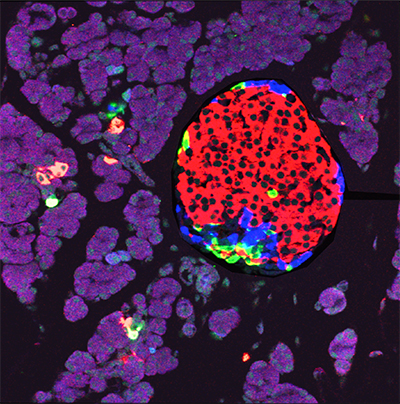
Micrograph of an adult mouse pancreatic islet with immunofluorescence staining for (A) glucagon (α cells, blue), insulin (β cells, red), and somatostatin (δ cells, green). The high pinkish background tissues are mostly acinar and duct cells. Image kindly provided by Guoquiang Gu. Copyright 2019. The pancreatic islets of Langerhans are… Read MoreJanuary 31, 2019
-

Caprioli Earns 2019 ABRF Annual Award for Outstanding Contributions to Biomolecular Technologies
The 2019 ABRF Annual Award for Outstanding Contributions to Biomolecular Technologies will be presented to Richard M. Caprioli, the Stanford Moore Professor of Biochemistry and Director of the Mass Spectrometry Research Center at Vanderbilt University School of Medicine. Dr. Caprioli’s research focuses on the discovery of temporal and spatial processes… Read MoreJanuary 28, 2019
-

Crowe leads ‘sprint’ to find anti-Zika antibodies
by Bill Snyder Scientists at Vanderbilt University Medical Center and colleagues in Boston, Seattle and St. Louis are racing to develop — in a mere 90 days — a protective antibody-based treatment that can stop the spread of the Zika virus. This is the first of four “scientific sprints” sponsored… Read MoreJanuary 25, 2019
-

American Chemical Society honors Lindsley’s research
Jan. 24, 2019, 10:26 AM by Bill Snyder The year is starting off with a bang for Craig Lindsley, PhD, director of medicinal chemistry in the Vanderbilt Center for Neuroscience Drug Discovery (VCNDD). Craig Lindsley, PhD Earlier this month Lindsley won the inaugural Scientific Achievement Award in Drug Discovery… Read MoreJanuary 25, 2019