
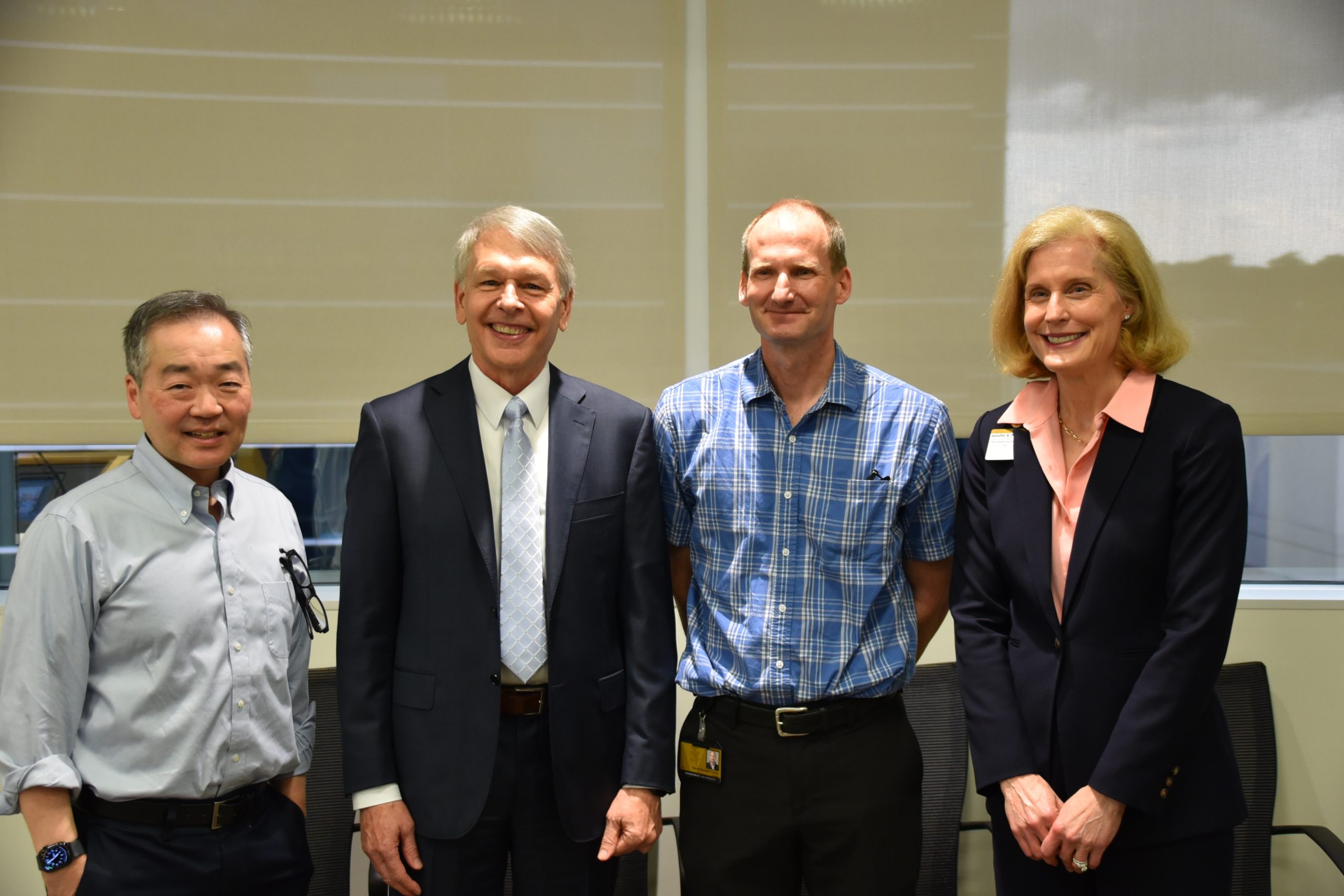
Scott Hiebert, Hortense B. Ingram Chair in Cancer Research, professor of biochemistry, and associate professor of medicine, has been named Chief Scientific Officer of the Cancer Prevention and Research Institute of Texas, effective Aug. 1. Hiebert will retire from Vanderbilt after 28 years of distinguished service.
“Dr. Hiebert has been a foundational leader in cancer research at Vanderbilt,” said Jennifer Pietenpol, chief scientific and strategy officer and executive vice president for research at Vanderbilt University Medical Center. “His scientific brilliance, deep integrity, and generous leadership and mentorship have shaped not only the success of Vanderbilt-Ingram Cancer Center but also the careers of countless investigators. I can think of no better person to lead CPRIT at this pivotal moment. Scott will bring vision, rigor, and heart to advancing cancer discovery and prevention across the State of Texas and beyond.”
CPRIT is the second-largest public funder of cancer research in the U.S., following only the National Cancer Institute. As Chief Scientific Officer, Hiebert will be the new chief scientific officer. To date, the agency has awarded more than $3.9 billion in grants to Texas research institutions and organizations through its academic research, prevention, and product development research programs.
“Scott’s impact on Vanderbilt cannot be overstated. His scientific achievements, mentorship, and leadership have elevated our community and made a lasting mark on cancer research,” said John Kuriyan, dean of the School of Medicine Basic Sciences. “We are enormously proud of his appointment as Chief Scientific Officer of CPRIT, where his vision and experience will continue advancing discoveries that improve lives.”
Hiebert joined Vanderbilt’s Department of Biochemistry in 1997 and received the Hortense B. Ingram Chair in 2013. A global leader in understanding the genetic mechanisms behind cancer, he has authored nearly 200 publications, earned prestigious awards such as the Ernest W. Goodpasture Award and the T.J. Martell Medical Research Advancement Award, and influenced generations of scientists.
“It’s been a huge honor to work at Vanderbilt and to be involved with the VICC. The support that I was given and the facilities and shared resources allowed my lab to tackle some really fun challenges,” Hiebert said. “I had always planned to retire early and had planned to continue to work with the Edward P. Evans Foundation to fund research during my retirement, but the opportunity with the CPRIT was just too good too pass up. CPRIT spends about $280 million per year supporting cancer research and prevention in Texas, so it’s an opportunity to give back to cancer research in the final phase of my career.” Hiebert is the current chair of the Scientific Advisory Board of the Edward P. Evans Foundation.
“Dr. Hiebert brings a powerful combination of scientific knowledge and national leadership to CPRIT,” said CPRIT CEO Kristen Doyle in a release. “As Chief Scientific Officer, his experience and vision will ensure CPRIT funding is driving innovation in cancer research and keeping Texas at the forefront in the global fight against cancer.”
Hiebert has mentored nearly 50 trainees, including postdoctoral fellows, clinical fellows, and Ph.D. students, many of whom are now at leading institutions and companies. His design of the Biochemistry 302/8302 course and tenure as director of graduate studies of his department significantly shaped Vanderbilt’s educational programs, and his leadership on major training grants has supported dozens of early-career researchers. One of his clinical fellows, Chris Williams, is now director of the Vanderbilt Medical Scientist Training Program.
“In addition to his groundbreaking discoveries on gene expression and cancer, Scott has been a terrific colleague who has made huge contributions to Vanderbilt and the wider scientific community,” said Dave Cortez, Richard N. Armstrong Ph.D. Chair for Innovation in Biochemistry and chair of the Department of Biochemistry. “His leadership in the VICC has been truly remarkable, making it a world-leading center for research and education. I am excited that he will bring his expertise and joy for science to his position as the next Chief Scientific Officer of CPRIT.”
Nationally, Hiebert has played a pivotal role in shaping cancer research strategy and policy. He served on the National Cancer Advisory Board from 2020–22 and on the Frederick National Laboratory Advisory committee. His research illuminated how key gene fusions drive aggressive cancers such as acute myeloid leukemia and rhabdomyosarcoma, combining cutting-edge genetics and biochemistry to yield new insights and potential therapeutic avenues.
At the VICC, Hiebert’s role as associate director for shared resources strengthened the center’s mission to integrate cancer research and patient care, support young investigators, and promote collaborative discovery. Through his leadership of pilot project funding and American Cancer Society Institutional Research Grants, he enabled hundreds of careers to take flight.
Hiebert received a B.S. from Bethel College and a Ph.D. from Northwestern University, which was followed by postdoctoral work at Duke University as an American Cancer Society fellow and a Howard Hughes Research Associate.