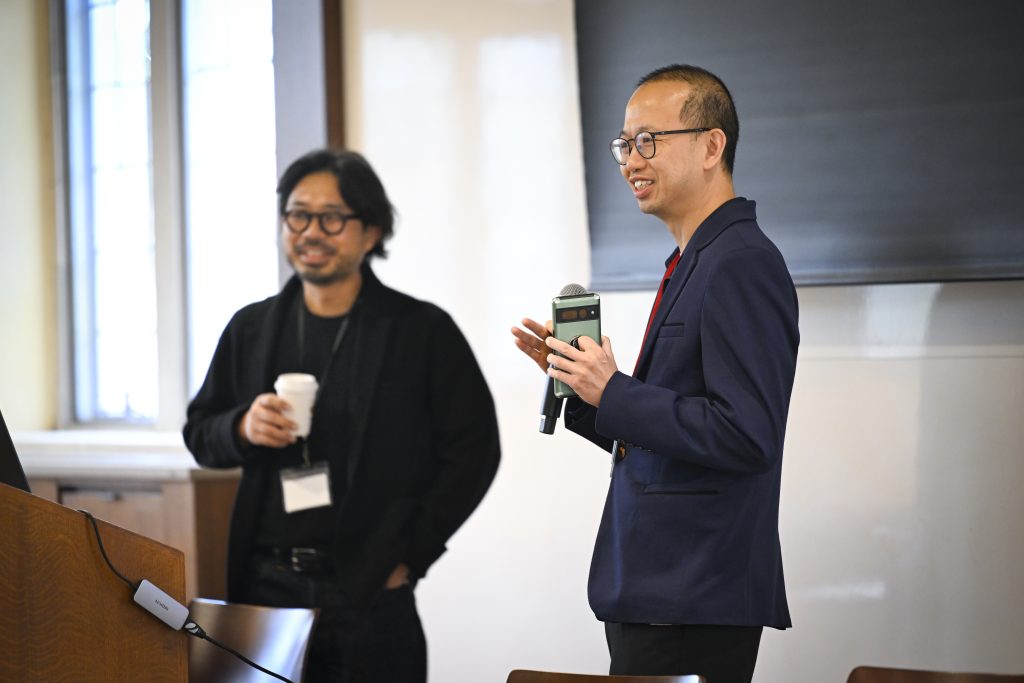
The Center for Computational Systems Biology at Vanderbilt University hosted its inaugural Symposium on AI, Spatial & Systems Biology on Oct. 11–12 at Alumni Hall, bringing together international leaders in the fields of artificial intelligence, spatial biology, and systems biology. The two-day event highlighted how emerging 3D AI technologies are transforming biomedical research, ushering in a new era of discovery that bridges molecular, cellular, and systems-level understanding of biology.
“The biological sciences are entering a transformative era,” said Ken Lau, director of the CCSB and professor of cell and developmental biology. “For decades, biology has been largely two-dimensional.” With recent advances in 3D imaging and AI, visualizing living systems in their native architecture is now possible, enabling a more complete understanding of how cells and tissues interact in health and disease. 3D AI is particularly critical for understanding how cancers evolve, how immune cells interact with tissues, and how drugs alter complex biological systems. “3D AI represents the next frontier in biomedical science, promising a leap from static descriptions to dynamic, holistic understanding,” Lau said.
“At Vanderbilt, where AI, surgery, pathology, and systems biology work side-by-side, this integrated environment is accelerating biomarker discovery, sharpening trial design—from intraoperative imaging to spatially informed enrollment—and translating rigorously validated tools to the clinic,” Tae Hyun Hwang said. Hwang is the director of the Molecular AI Initiative at the Vanderbilt University Medical Center, an executive member of the CCSB, and a co-organizer of the symposium along with Lau.

The symposium aimed to create a forum where engineers, computational scientists, and biologists could connect about this transformative era featuring 3D AI. The program included a world-class lineup of speakers whose research is shaping the future of 3D AI in biomedical science.
The keynote address was delivered by Jonathan Liu of Stanford University, inventor of hybrid open-top light-sheet microscopy. Other presenters included Ashley Kiemen from Johns Hopkins University, Linghua Wang from MD Anderson Cancer Center, Mingyao Li from the University of Pennsylvania, Sandro Santagata from Harvard Medical School, Yang Liu from University of Illinois Urbana-Champaign, and Young Hwan Chang from Oregon Health & Science University, among others.
Sessions spanned topics from AI algorithm development and 3D imaging to clinical translation and large-scale tissue reconstruction. Among the key takeaways were the need for next-generation hardware investment, the ability to detect new biological structures in 3D, and the recognition that clinical integration of AI-driven pathology remains a work in progress that requires greater engagement from medical professionals.
The symposium also highlighted the importance of collaboration between academia and industry. Representatives from Bruker, 10X Genomics, Singular Genomics, Element Biosciences, LG AI Research, and Tomocube shared insights into technologies driving the interface between AI and biology. Notably, executives from VPIX Medical and Meteor Biosciences traveled from Korea to participate in person, underscoring the global reach of the event.
“These partnerships open doors for future collaborations, funding opportunities, and tool development that directly benefit Vanderbilt researchers,” Lau said, to which Hwang added, “And the collaborations launched here across academia, health systems, and industry will bring better therapies to patients sooner.”
Speakers and participants praised the symposium’s organization, scientific depth, and collaborative spirit. Tom Kelly, director of single cell and spatial sales at Element Biosciences said, “The symposium had great discussions, good engagement, and impressive scientific stories.”
“Friendship and collaboration in the spirit of team science” was apparent throughout the event, according to Lau. The CCSB envisions the symposium as the beginning of a continuing series that will foster cross-disciplinary partnerships, inspire trainees, and accelerate discovery in AI and systems biology.