Research, News & Discoveries
-

Discovery of mosquito survival tactics leaves room for new disease vector control tactics
The appendages that protrude from a mosquito’s head hold the sensory systems that account for nearly all of its ability to detect and respond to a wide range of chemical signals that are critical for its reproduction and its survival. At the molecular level, these systems rely on genes that… Read MoreJun. 1, 2022
-

Diabetes, cardiovascular drug targets
Type 2 diabetes, which affects more than 30 million Americans, increases risk of cardiovascular disease. Nearly 70% of people with Type 2 diabetes die from heart disease or stroke. Maureen Gannon, PhD, and colleagues investigated the role of the inflammatory lipid signaling molecule PGE2 — acting through… Read MoreMay. 26, 2022
-

Study identifies first cellular “chaperone” for zinc, sheds light on worldwide public health problem of zinc deficiency
We need zinc: one-tenth of the proteins in our cells require this metal for their normal functions in all aspects of cell metabolism. We acquire zinc by eating it — in foods or multivitamin supplements — but up to 30% of people in some parts of the world are at… Read MoreMay. 19, 2022
-
Molecular ‘switch’ may illuminate stomach disorders
An international team that included researchers from Vanderbilt University Medical Center has discovered a molecular switch that induces rapid proliferation of zymogen granule-secreting chief cells in the stomach to regenerate damaged tissue. The finding, which was reported earlier this month in the journal Cell Stem Cell, may be crucial… Read MoreMay. 19, 2022
-
Study sheds light on the dark side of obesity
Obesity is an inflammatory condition that can damage tissues throughout the body, resulting in increased risk for cardiovascular disease, insulin resistance, type 2 diabetes and possibly kidney disease. The agents of inflammation are immune cells called macrophages, which accumulate in fatty tissue, and which produce inflammatory chemicals called cytokines. But… Read MoreMay. 17, 2022
-
Collaborative research yields new protein structure
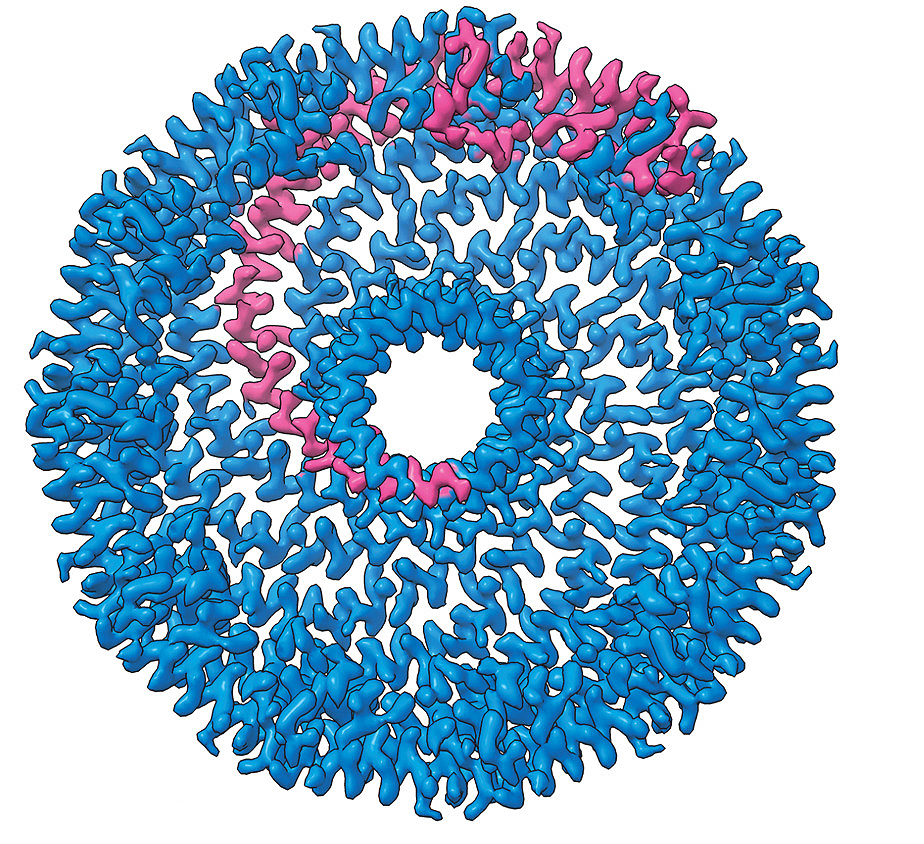
Structure of a caveolin-1 complex obtained using cryo-electron microscopy. A protomer, or a structural unit, is highlighted in magenta. The image was cropped to focus on panel A of Figure 1 of the paper, modified and published here in accordance to a CC BY-NC 4.0 license. Read MoreMay. 16, 2022
-

Vanderbilt University honors emeritus and emerita faculty
Vanderbilt University has honored 35 retiring faculty members for their years of service by bestowing upon them the title of emerita or emeritus faculty. They were recognized during Vanderbilt’s Commencement ceremony on May 13. A faculty member who has served the university with distinction over a period of years and… Read MoreMay. 13, 2022
-

Resistance to COVID-19 drug detected in lab study
The virus that causes COVID-19 can develop partial resistance to the antiviral drug remdesivir during infection of cultured cells in the laboratory by more than one mechanism. The results of the laboratory study led by researchers at Vanderbilt University Medical Center and published April 28 in the journal Science… Read MoreMay. 12, 2022
-
Resistance to COVID-19 drug detected in lab study
The virus that causes COVID-19 can develop partial resistance to the antiviral drug remdesivir during infection of cultured cells in the laboratory by more than one mechanism. The results of the laboratory study led by researchers at Vanderbilt University Medical Center and published April 28 in the journal Science… Read MoreMay. 12, 2022
-
Cryo-EM reveals the molecular mechanism of IP3 receptor channel opening
Research led by co-first authors Emily Schmitz, a graduate student in the Chemical and Physical Biology program, and Hirohide Takahashi, a research instructor in molecular physiology and biophysics, identified the structure of the human type-3 inositol 1,4,5-triphosphate, or IP3, receptor in several conformations using cryo-electron microscopy. Schmitz and Takahasi, who… Read MoreMay. 9, 2022