Career Exploration
Career Exploration
Not sure where to start, or have no idea what you can do with a PhD after you graduate? As you begin thinking about your career, consider the things that are important to you. What do you enjoy doing? What do you not enjoy doing? What kind of work-life balance do you want to have? Is there a specific location you want to work in? Knowing what’s important to you before you start your journey will help you begin to narrow down the choices. Check out these resources to get started on your career exploration!
Overview
A PhD opens up a number of career opportunities, both within academia, industry, and beyond. Exploring the variety of options early on can help you see what resonates with your interests, values, and long-term goals.
What can you do with a PhD? – Check out this ASPIRE slide deck that highlights various career paths you can take with a PhD.
Industry Careers Overview & Job Packages (NIH, 2021) – This YouTube video from the NIH Career Symposium provides an overview of industry-related careers.
Want to learn more about industry-related careers? Check out Jobs You Can Do With a Science Ph.D., Beyond Academia.
Where do most of our graduates end up?
The “From goal to outcome: Analyzing the progression of biomedical sciences PhD careers in a longitudinal study using an expanded taxonomy” article, written by the Vanderbilt BRET team, examined how career goals of Vanderbilt’s biomedical PhD graduates (1997-2021) evolved during their training and tracked their career paths in the years after graduation. The paper also provides a three-tiered career taxonomy (career sector → career type → job function) in the supplemental materials, which may serve as a useful framework to explore potential pathways or job titles within each category.
Self-assessment
A good place to begin career exploration is by reflecting on your own values, interests, and skills. Ask yourself: What am I good at? What do I enjoy doing the most? What leaves me feeling drained? What matters to me in terms of work-life balance, location, or type of impact? Thinking through these questions can help you start narrowing down career paths that align with who you are.
- myIDP (AAAS) – Complete this free assessment to learn how your interests, values, and skills align with various PhD career paths.
- Check out the resources on the ASPIRE Exploration, Self-Assessment, and Goal Settings page.
Learn from others
Once you have a sense of what’s important to you in your career, the next step is to learn from others who share similar values, interests, and skills. Hearing how they navigated their paths can give you practical insights into different career options and help you see how your strengths might translate into various roles.
- Beyond the Lab Podcast and Video series – Check out the podcast and video series where Kate Stuart sits down with our alumni, where they take a deep dive into how they got into their careers, what their day-to-day looks like, and advice they have for those interested in a similar career.
- Beyond the Professoriate – This is a free resource for Vanderbilt trainees and offers an extensive range of resources to help PhD graduate students and postdocs understand and evaluate career options. They have a vast interview library, career assessment tools, and live webinars to help navigate your career exploration.
Skill Development
As you are exploring different careers, pay attention to the skills that are most relevant. What can you be doing now to expand upon those skills? Take advantage of courses or ASPIRE modules, the ASPIRE UP series, or gain hands-on experience, such as internships or volunteering. Expanding upon these skills early will ensure you are more prepared when opportunities arise.
For additional ways to develop your skills, check out the Path to Career Skill Development page.
Get involved/explore resources
The ASPIRE team has gathered resources from Vanderbilt, local, state, and national levels to help you get involved in various career exploration opportunities.
- ASPIRE’s Curated Career Resources: Clinical Research
- ASPIRE’s Curated Career Resources: Data Science and Programming Resources
- ASPIRE’s Curated Career Resources: Medical Writing and Communication
- ASPIRE’s Curated Career Resources: Patent Law
- ASPIRE’s Curated Career Resources: Business and Entrepreneurship
- ASPIRE’s Curated Career Resources: Teaching
Career Exploration FAQ
- How early in my training should I start thinking about careers?
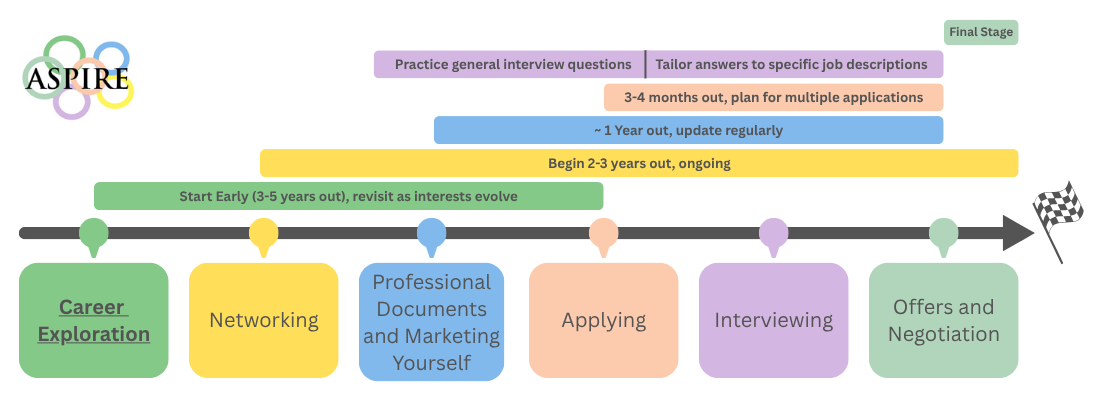
- It’s never too early to start exploring. Even if you are still several years out, you can begin reflecting on your interests, values, and strengths. You don’t have to make decisions right away, but think of it as gathering information. Early exploration gives you more time to build relevant skills, network, and identify opportunities that align with your goals.
- I don’t know where to begin… what should I do to look for what job is best for me?
- Start with self-assessment. Think about what motivates you, what you are good at, and what kind of work environment you enjoy. Tools like the myIDP or the ASPIRE Self-Assessment and Goal Setting resources can help clarify your interests. You can also check out the Beyond the Lab podcast series to listen to informational interviews from alumni, or schedule an individual advising appointment to talk through different career options with a member from the ASPIRE team.
- What if I am interested in multiple career paths? How do I narrow them down?
- Try exploring your different career interests in low-commitment ways – attend ASPIRE Ph.D. Career Stories to hear about the career paths of those working in the fields you are interested in, or conduct informational interviews with those in the various fields to determine whether that field would be a good fit for you. As you learn more, compare how each option aligns with your personal priorities, such as work-life balance and long-term goals. As you begin to narrow down your interests, one of the best ways to determine if a field is a good fit is to participate in an internship to gain hands-on experience.
- What do I do if I am still interested in benchwork, but I don’t want to be in academia?
- If you are interested in benchwork but aren’t drawn to the academic path, there are plenty of opportunities to stay at the bench. Industry research roles in biotech and pharma, government labs, core facilities, contract research organizations (CROs), or startups can all allow you to apply your technical skills while contributing to larger, team-driven projects.
- What are the resources/companies that are in X city?
- Start by exploring the biotech ecosystem in your city of interest. BioSpace has ways to identify companies by region, and many states have Bioscience Organizations (i.e., Life Science Tennessee) where you can learn about upcoming events and career resources.
- Should I do a postdoc for ___ career?
- Doing a postdoc depends on your career goals. For many industry research, government, or science policy roles, a postdoc is not required – although it may be beneficial if you seek to gain specific technical experience with your target job. However, if you are seeking a faculty position or a research-intensive role in industry, a postdoc (or industry-specific postdoc) is often expected. If you are uncertain, look up job postings in your desired field and check whether a postdoc is listed as a preferred or required qualification. You can also reach out to professionals in that field (see Networking) to see how they navigated that decision.